
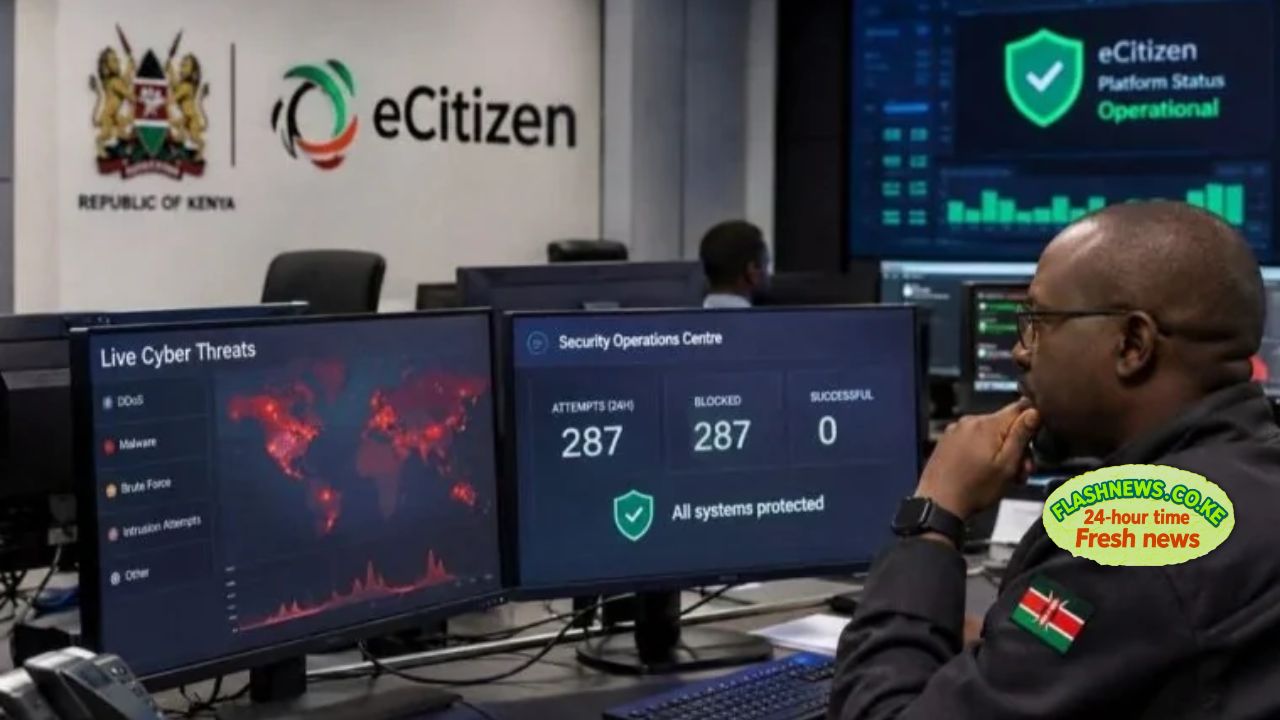
A senior executive associated with Kenya's eCitizen platform has disputed claims that hackers successfully accessed and leaked personal information belonging to millions of Kenyans, insisting that the system has not suffered a successful cyberattack resulting in data loss in nearly 14 years.eCitizen Data Breach: David Kiprono Challenges Leak Claims
Sign up to Flash News
Your info will be used in accordance with our Privacy Policy
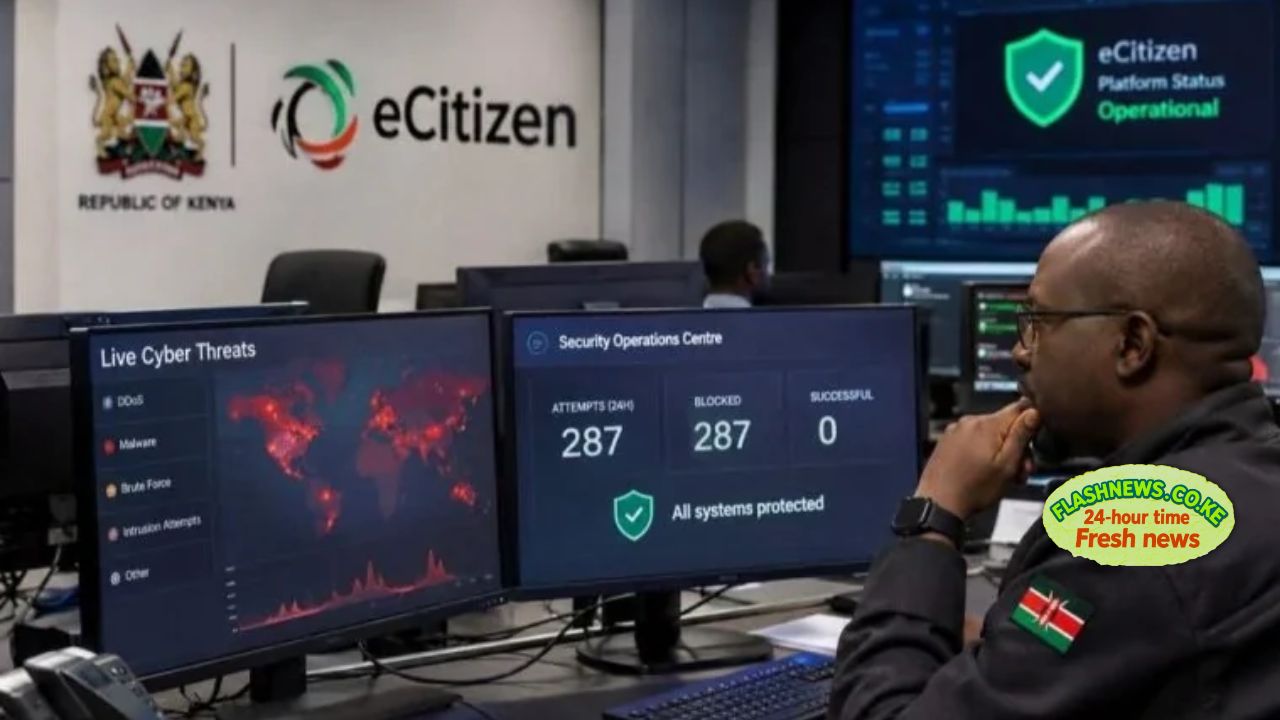
David Kiprono, Director of Government Relations and Public Affairs at Electronic Citizen Solutions (ECS), issued a detailed statement on Saturday, November 28, 2026, responding to allegations that an entity calling itself ByteToBreach had stolen approximately 740GB of information from the government platform.
His response comes as concerns grow over reports that files containing identity documents, database records and other sensitive information have been advertised on an underground online forum.
The government had already acknowledged reports of unauthorised access and confirmed that technical teams were investigating the incident. The State Department for Immigration and Citizen Services also said eCitizen services remained operational.
What David Kiprono says about the eCitizen data breach
Kiprono said the platform's historical security records showed no successful cyberattack resulting in the loss of citizens' data since its development and deployment.
He maintained that eCitizen had faced numerous attempted attacks over the years but had continued operating while security teams monitored and responded to threats.
"For nearly 14 years, since the initial development and deployment of eCitizen, even when it operated purely as Software as a Service (SaaS), our historical security records show that we have not lost data through a successful cyberattack," he stated.
The executive acknowledged that the platform experienced a major cyber incident in 2023 but described it as a Distributed Denial of Service (DDoS) attack rather than a confirmed incident involving stolen personal information.
A DDoS attack occurs when attackers overwhelm a website or online service with excessive traffic, making it difficult for legitimate users to access it.
Kiprono compared the incident to deliberately blocking the entrance of a building. People may be prevented from entering, but that does not automatically mean someone has broken inside or stolen property.
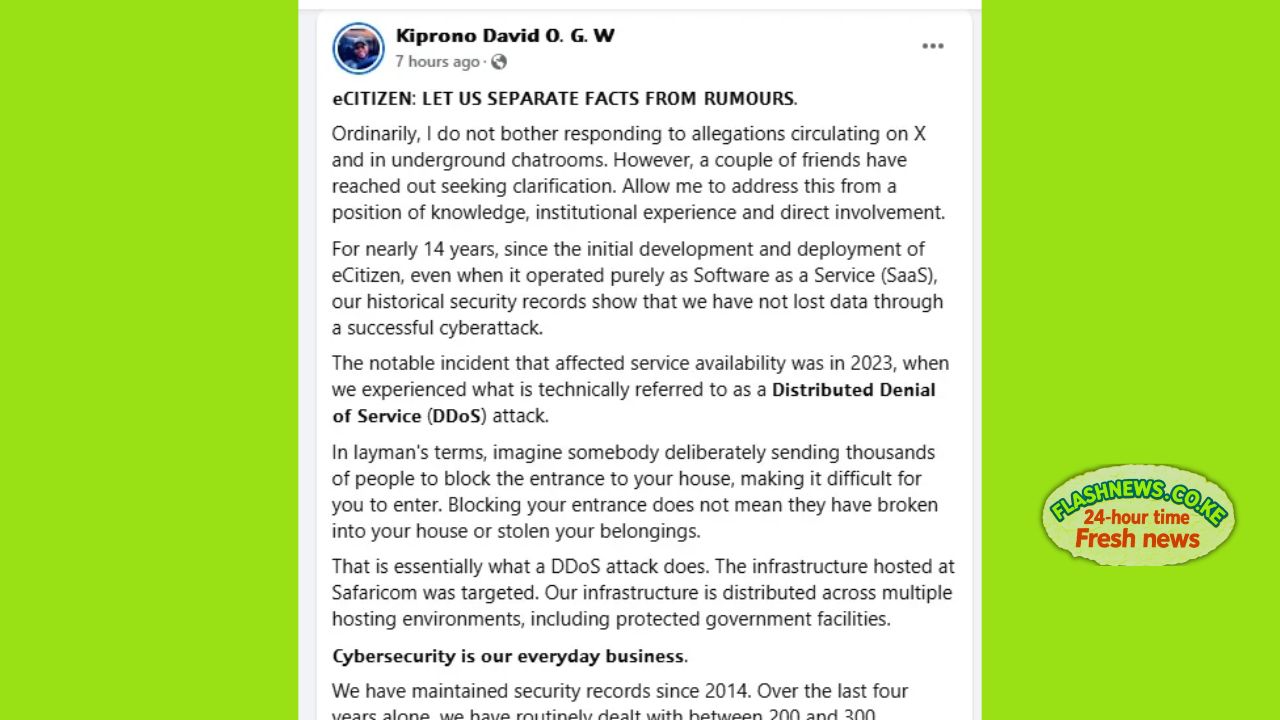
He also said the infrastructure affected during the 2023 incident was hosted at Safaricom, while eCitizen's wider infrastructure operates across different hosting environments, including protected government facilities.
Kiprono reveals daily cyberattack attempts
The ECS director further claimed that eCitizen routinely handles between 200 and 300 attempted cyberattacks every day.
According to him, the threats are monitored and addressed through cybersecurity technologies as part of the platform's normal operations.
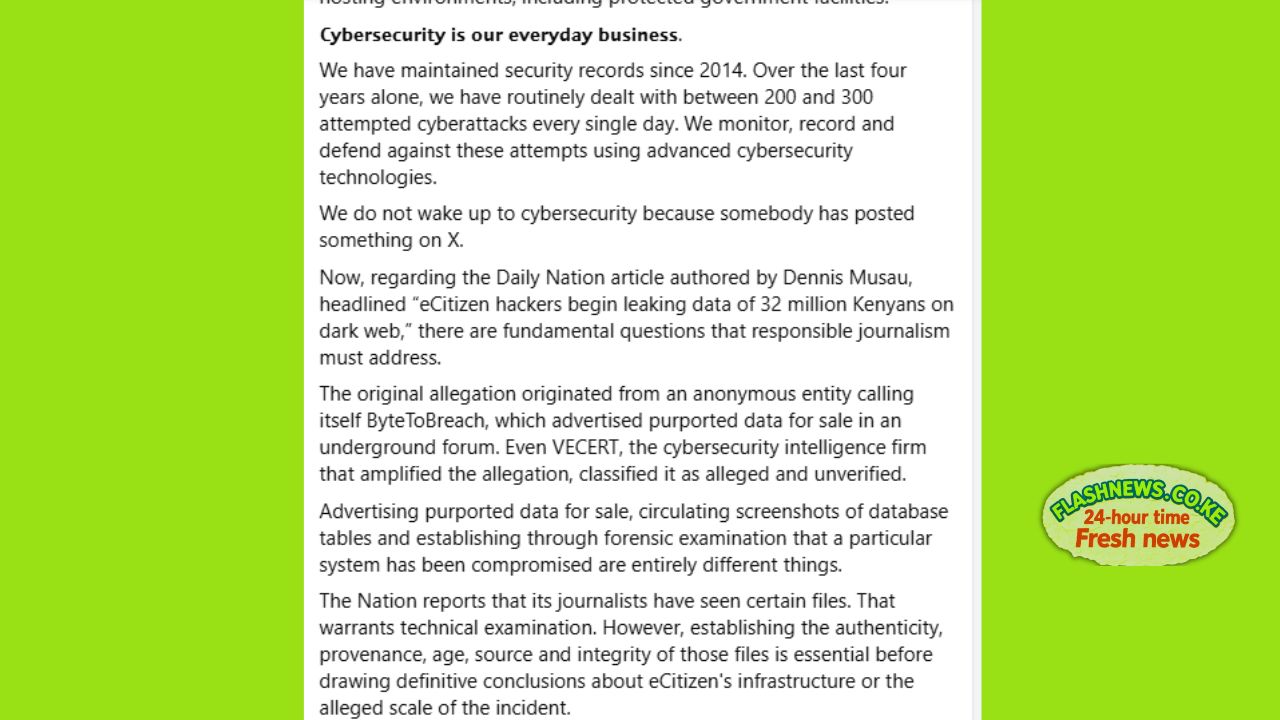
"Over the last four years alone, we have routinely dealt with between 200 and 300 attempted cyberattacks every single day," he said.
He rejected suggestions that the platform only pays attention to cybersecurity after allegations become public, arguing that monitoring and defence against threats are continuous responsibilities.
The comments come as Kenya's digital infrastructure faces increased scrutiny following several cyber incidents targeting government websites and online services.
Flash News previously examined concerns over cyberattacks targeting government websites, highlighting the importance of protecting public systems that citizens increasingly depend on.
Questions over the alleged 740GB data theft
At the centre of the latest controversy is ByteToBreach, an entity that has claimed responsibility for accessing eCitizen information and advertising purportedly stolen files.
The alleged archive is said to contain approximately 600GB of Know Your Customer (KYC) documents, 100GB of database content and 40GB of source code.
KYC documents are records used to establish a person's identity. They may include information contained in national identity documents, passports and other identification materials.
Reports published on November 28 also raised concerns about files allegedly containing records associated with more than 32 million people, including identity details, photographs, dates of birth and other sensitive information.
Kiprono challenged the evidence being used to support the allegations, arguing that an advertisement by an anonymous online seller does not independently establish that a government system was successfully compromised.
He also questioned the authenticity, origin, age and integrity of the files reportedly seen by journalists.
"Advertising purported data for sale, circulating screenshots of database tables and establishing through forensic examination that a particular system has been compromised are entirely different things," he stated.
The executive referenced cybersecurity intelligence firm VECERT, which he said had characterised the claims as alleged and unverified.
He called for credible evidence to be submitted securely for independent forensic examination, warning that publishing citizens' private information in the process could expose them to further harm.
Government had already launched investigations
Kiprono's statement followed an earlier announcement by the State Department for Immigration and Citizen Services acknowledging reports of unauthorised access to eCitizen user information.
In its November 24 communication, the department said technical and security teams were working with other government agencies to establish the extent of the reported incident.
It also assured the public that the platform remained available and that Kenyans could continue accessing government services.
The department urged users to remain alert to suspicious calls, text messages, emails and links that might exploit public concern over the alleged incident.
It advised account holders to avoid sharing passwords and one-time PINs (OTPs), and encouraged those reusing passwords across different platforms to change them.
The government's investigation is particularly important because eCitizen serves as a central gateway to numerous public services. Any confirmed exposure of sensitive information could have implications beyond the platform itself.
Cybersecurity reporting has also raised questions about possible access to authentication systems used by connected public institutions. However, the alleged impact on those separate institutions has not been independently established.
Director criticises media reporting
Kiprono also criticised the coverage of the alleged incident, arguing that journalists reporting on critical national infrastructure should distinguish between claims made by anonymous online actors and findings established through technical investigations.
He specifically referred to coverage of the alleged leaking of information belonging to 32 million Kenyans.
"A sensational headline is not a forensic report. A screenshot is not a technical audit. An anonymous seller's advertisement is not proof of a successful intrusion," he stated.
He warned that unverified claims could create unnecessary public anxiety and undermine confidence in digital government services.
The director also urged journalists to exercise caution when handling information that may contain citizens' identification details, biometric records and other private information.
His position is that the authenticity of the purported files must be established before the extent of any compromise can be determined.
eCitizen users warned against sharing passwords and OTPs
Kiprono used his statement to remind Kenyans to take responsibility for protecting their digital accounts.
He cautioned users against giving their login details to cybercafé attendants, brokers, friends or other third parties, even when seeking assistance with government services.
He also advised account holders to ensure that the telephone numbers and email addresses registered against their national identification details belong to them.
"We have strengthened our login protocols. Ensure that the email address and telephone number registered against your national ID belong to you," he said.
He warned that OTPs should only be received and used by the registered account holder.
"Your OTP must come to you, the registered account holder," he added.
Kenyans have previously been warned about online schemes designed to steal passwords and personal information. Flash News has explained how phishing scams target personal details, including through deceptive messages and links.
Users should also avoid opening suspicious attachments or responding to unsolicited messages claiming that their eCitizen accounts have been compromised.
The Office of the Data Protection Commissioner provides an official data breach reporting channel for organisations required to notify the regulator. Its guidance under the Data Protection Act also outlines obligations relating to notifying affected individuals and reporting qualifying breaches.
eCitizen remains operational as questions persist
Despite the controversy, Kiprono maintained that the platform remained operational and that the company was focused on protecting the system.
He defended eCitizen as a Kenyan-developed technology platform deployed at national scale, adding that the country's expertise in digital services continued to attract interest from other African countries.
He also argued that an attempted cyberattack, an alleged breach and a confirmed data breach should not be treated as interchangeable terms.
"An attempted attack, an alleged breach and an actual breach are three fundamentally different things," he said.
The government investigation will be important in establishing whether unauthorised access occurred, what information may have been exposed and whether citizens need to take additional protective measures.
For now, Kenyans should use official eCitizen channels, keep their login credentials private and remain cautious of messages requesting personal information. The next significant development will be the findings of the technical investigations and any formal guidance issued by the government or data protection authorities.