






IFAB Changes Penalty Rules After Alvarez Double-Touch Incident in Champions League
The International Football Association Board (IFAB) has officially revised its rules regarding penalty kicks, following a high-profile and contentious incident involving Atletico Madrid’s Julian Alvarez in the UEFA Champions League.
The updated law, which takes immediate effect, mandates a retake for any penalty where a player unintentionally makes a ‘double touch’—a significant shift from previous rulings that disallowed the goal outright.
The controversy unfolded during the Round of 16 clash between Atletico Madrid and cross-city rivals Real Madrid earlier this year. The match, which extended over two legs and ultimately required extra time and penalties to determine a winner, captivated fans with its intensity and drama.
After 210 minutes of football, the aggregate score stood at 2-2. Real Madrid had secured a 2-1 win at the Santiago Bernabeu in the first leg, courtesy of a second-half goal by Brahim Diaz. Atletico Madrid responded in the second leg with an early strike from Conor Gallagher, leveling the tie and forcing the match into extra time and a subsequent penalty shootout.
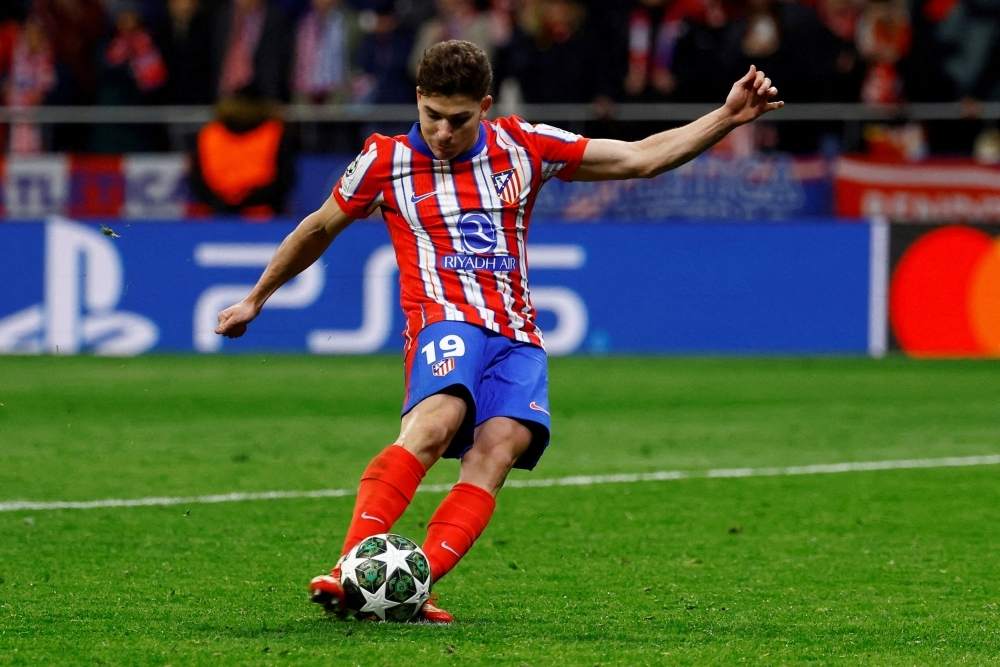
It was during the shootout that the most debated moment of the tie occurred. Julian Alvarez, a World Cup-winning forward, approached his spot-kick only to lose his footing. As he slipped, his standing foot appeared to make contact with the ball just before he struck it into the net.
Despite the ball finding its way past Real Madrid goalkeeper Thibaut Courtois, Polish referee Szymon Marciniak disallowed the goal for an illegal ‘double touch’—a decision supported by UEFA under the then-existing rules.
The call sparked immediate backlash from Atletico Madrid players and staff, with head coach Diego Simeone publicly challenging the decision. Speaking to the media post-match, Simeone expressed his disbelief and frustration.
“Did you guys see it? Did you see it? Did he or didn’t he touch the ball?” Simeone questioned during a heated press conference, as reported by Sky Sports. “Don’t be afraid to speak. Are you afraid because you’re going to be punished? If you’re afraid, don’t say anything. Raise your hand if you think Julian knocked twice. No one? No one. Okay.” He continued, “The referee said that when Julian stepped and kicked, he touched the ball with his foot, but the ball didn’t move. That’s something to discuss about whether it was a goal or not, but I’m proud of my players.”
In response to the incident and growing concern over the interpretation of the rule, IFAB acted swiftly. The governing body clarified that going forward, if a penalty taker unintentionally contacts the ball with both feet or with their non-kicking foot immediately after striking it, and the ball goes in, the penalty will be retaken, not disallowed. If the attempt is unsuccessful, an indirect free kick will be awarded to the opposing team.
“The penalty taker accidentally kicks the ball with both feet simultaneously or the ball touches their non-kicking foot or leg immediately after the kick: if the kick is successful, it is retaken,” stated IFAB in its official communication. “If the kick is unsuccessful, an indirect free kick is awarded… or, in the case of penalties (penalty shoot-out), the kick is recorded as missed.”
The rule change has been circulated to all FIFA member associations and is effective immediately. This means that the updated regulations could be applied as soon as the upcoming FIFA Club World Cup, and may also feature in the UEFA Nations League semi-finals and finals this week, as well as the ongoing World Cup qualifiers.
The update reflects IFAB’s commitment to ensuring fairness and clarity in the game’s most critical moments and follows a growing trend of rapid rule adaptations in response to modern football’s evolving challenges.
Also Read: Bruno Fernandes Set to Stay at Manchester United — Why His Presence Goes Beyond Football
IFAB Changes Penalty Rules After Alvarez Double-Touch Incident in Champions League