


More than 1.2 million Grade 9 learners are expected to complete the 2026 Kenya Junior School Education Assessment (KJSEA) on Friday, October 30, marking an important milestone in the implementation of Competency-Based Education (CBE).
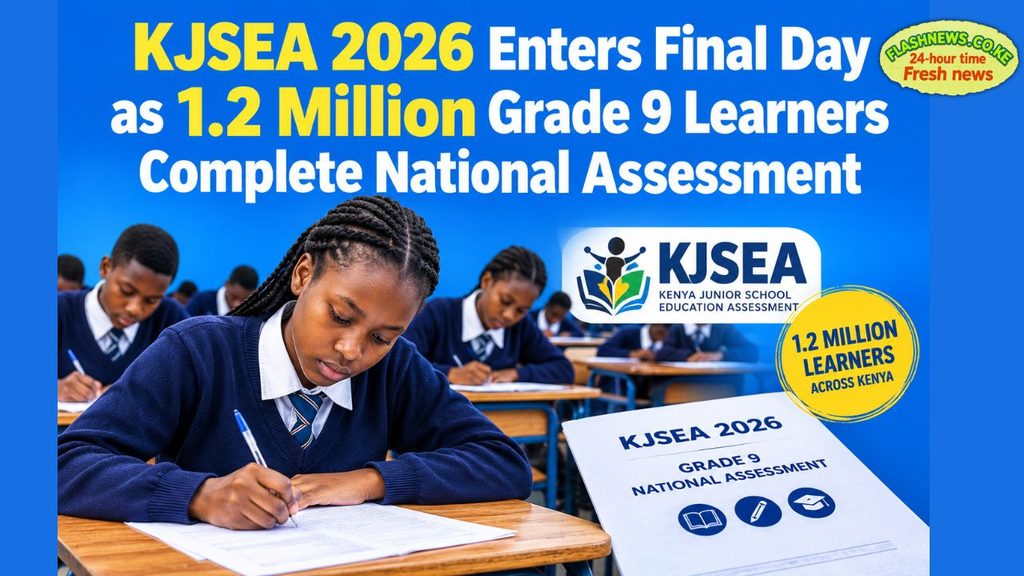
The final assessment papers are scheduled for today, bringing to an end a national exercise that began on Monday, October 26, following a rehearsal held on October 23.
A total of 1,206,028 candidates registered for this year’s KJSEA, according to figures released by the Ministry of Education.
The assessment is particularly significant because it involves the pioneer cohort completing Grade 9 under the Competency-Based Curriculum and preparing to transition to senior school.
Parents, teachers and learners are now looking ahead to the next stage, including the processing of assessment outcomes and senior school placement arrangements.
Which KJSEA Papers Will Candidates Sit on Friday?
According to the revised timetable released by the Kenya National Examinations Council (KNEC), the final day of the 2026 KJSEA will feature Pre-Technical Studies and Religious Education.
The papers will bring the written assessment programme to a close after candidates have completed the scheduled learning areas throughout the week.
The assessment covers different learning areas under the junior school curriculum, including:
- English Language and Composition and Literary Analysis.
- Kiswahili and Kenyan Sign Language.
- Mathematics.
- Agriculture.
- Integrated Science.
- Social Studies.
- Creative Arts and Sports.
- Pre-Technical Studies.
- Religious Education.
The timetable also provides special arrangements for candidates using Braille and Kenyan Sign Language.
Candidates should follow instructions issued by their respective examination centre managers and invigilators.
How Many Learners Are Sitting the 2026 National Assessments?
The 2026 national assessment and examination exercise involves millions of learners across different education levels.
According to Education Cabinet Secretary Julius Ogamba, the registration figures include:
| Assessment or examination | Registered candidates |
|---|---|
| KPSEA – Grade 6 | 1,380,463 |
| KJSEA – Grade 9 | 1,206,028 |
| KCSE – Form Four | 1,048,355 |
| Total | 3,634,846 |
The figures demonstrate the scale of this year’s national examination programme.
The KJSEA is particularly important because it assesses the competencies acquired by learners before they proceed to senior school.
What Happens After KJSEA 2026?
Once the written assessments are completed, attention will shift to the processing of assessment information and the next stage of learner progression.
KJSEA is part of the competency-based assessment framework and is intended to provide information about learners’ progress and abilities.
The assessment outcomes will contribute to decisions relating to the transition of learners into senior school.
Parents should follow official Ministry of Education and KNEC announcements for information about results, placement arrangements and reporting dates.
It is important to distinguish between the completion of the assessment and the release of results. Finishing the final paper does not mean that results are immediately available.
How Will Grade 9 Learners Join Senior School?
Under the Competency-Based Education system, learners complete junior school before progressing to senior school.
Senior school provides learning opportunities through different pathways designed to support learners’ interests, abilities and future aspirations.
The pathways include:
1. STEM pathway
This focuses on Science, Technology, Engineering and Mathematics-related learning areas.
2. Social Sciences pathway
This provides opportunities in areas connected to humanities, languages, business and related fields.
3. Arts and Sports Science pathway
This supports learners interested in creative arts, performance, sports and related professional areas.
The placement process is intended to match learners with suitable senior school opportunities based on the applicable assessment and placement framework.
Parents should use official Ministry of Education guidance when making decisions about school selection and learner progression.
Government Explains Security Measures During National Assessments
Education CS Julius Ogamba has said the government introduced several measures to protect the integrity of the 2026 national assessments.
These include smart electronic padlocks for examination storage containers, colour-coded assessment materials and personalised question papers.
The government has also expanded the network of examination storage containers to improve access and reduce the distances examination officials travel to collect materials.
Ogamba said armed police officers would not routinely be stationed at KPSEA and KJSEA examination centres unless security circumstances required their presence.
Security personnel would continue to guard storage facilities and escort examination materials where necessary.
The measures are intended to safeguard the assessment process while ensuring that young learners complete their papers in an environment that does not create unnecessary anxiety.
What Parents Should Do After the Final KJSEA Paper
Parents and guardians should continue supporting learners as they complete the junior school assessment stage.
They should also avoid relying on unverified messages about examination results or senior school placement.
Important steps include:
- Confirming official announcements from KNEC and the Ministry of Education.
- Keeping learners’ school and assessment records safely.
- Following official guidance on senior school selection.
- Avoiding individuals demanding money to influence results or placement.
- Seeking clarification from school administrators where information is unclear.
Parents should also be cautious of fraudulent messages claiming to offer leaked examination papers or guaranteed placement opportunities.
Final Word
The completion of the 2026 KJSEA on October 30 will mark a major step for more than 1.2 million Grade 9 candidates preparing to move into senior school.
The assessment represents an important stage in the implementation of CBE and the transition of the pioneer junior school cohort.
As learners finish their final papers, attention will turn to the processing of assessment outcomes and the next phase of senior school progression.
Parents and learners should continue relying on official KNEC and Ministry of Education announcements for accurate information.
Also Read: MPs Give University of Nairobi Two Weeks to Explain Billions in Unpaid Pension Contributions and Taxes