


The University of Nairobi has been given two weeks by Members of Parliament to provide documentary evidence explaining billions of shillings in unpaid pension contributions and statutory deductions.
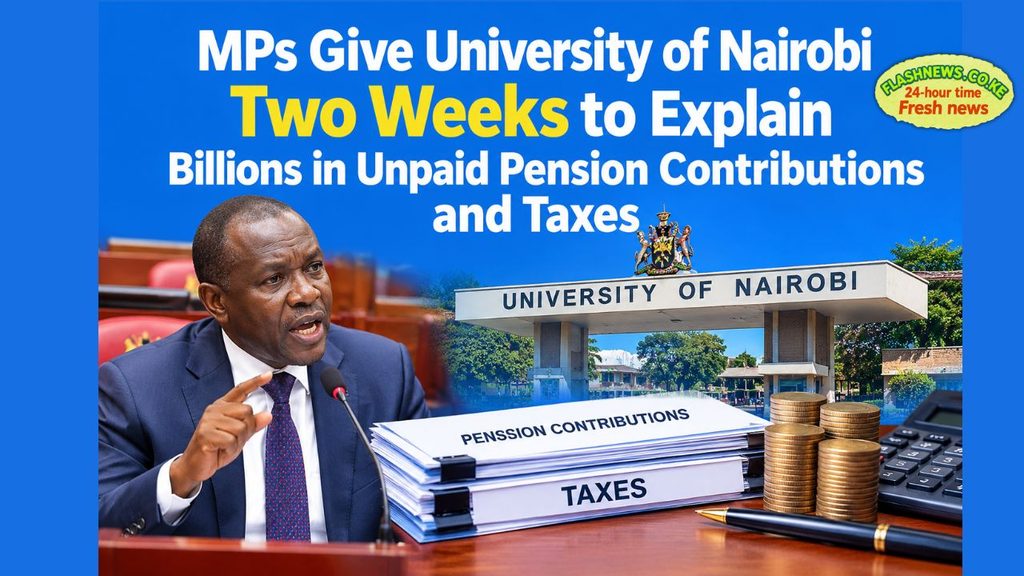
The directive was issued by the National Assembly Public Investments Committee on Governance and Education on October 29, 2026, following a review of the institution’s financial position and audit reports.
The committee questioned the university’s management over outstanding pension contributions, unpaid Pay As You Earn (PAYE) taxes and the measures being taken to settle the liabilities.
The inquiry has raised fresh questions about the financial management of one of Kenya’s largest public universities and the effect of unpaid statutory obligations on employees and institutional operations.
Why MPs Are Questioning University of Nairobi
The committee was reviewing Auditor-General reports covering the 2020/2021 to 2024/2025 financial years.
During the session, lawmakers sought explanations for the accumulation of pension and tax arrears, particularly money deducted from employees’ salaries but not remitted to the relevant institutions.
According to audit findings cited during the proceedings, the university failed to remit approximately KSh1.4 billion in pension contributions and KSh50 million in PAYE during the 2021/2022 financial year alone.
The figures prompted questions about how the liabilities accumulated and whether the university had taken sufficient action to address them.
Committee members also demanded supporting documents to establish whether management’s explanations and proposed recovery measures were backed by evidence.
University Management Asked to Produce Supporting Documents
The committee, chaired by Luanda MP Dick Maungu, directed the university to provide records explaining the outstanding liabilities within two weeks.
Lawmakers said verbal explanations were not sufficient to establish how the financial obligations had accumulated or whether the proposed solutions were working.
The documents are expected to help the committee assess payments made, engagements with relevant government agencies and the steps taken to resolve the outstanding obligations.
The inquiry forms part of parliamentary oversight of public institutions and their use of public resources.
University Reports Pension Deficit Exceeding KSh10 Billion
During the proceedings, Vice-Chancellor Professor Ayub Njoroge Gitau acknowledged that the university continued to face significant financial challenges.
He told the committee that the pension deficit had grown from approximately KSh5 billion to more than KSh10 billion.
The vice-chancellor said the institution had started paying pension benefits to retiring employees and had resumed remitting pension deductions in recent months.
He also indicated that the university was working with pension scheme trustees to develop a recovery plan.
Management further disclosed that it was exploring ways of using some of the institution’s land and other assets to help address its financial difficulties.
These proposals will require appropriate institutional and legal processes before any asset-related decisions can be implemented.
MPs Raise Questions Over Unpaid PAYE Taxes
The committee also questioned the university about unpaid PAYE obligations.
PAYE is the tax deducted from employees’ salaries and remitted to the Kenya Revenue Authority.
Failure to remit deducted taxes can expose institutions to additional liabilities, including penalties and interest where applicable.
Lawmakers sought clarification on the amount outstanding and the measures management had taken to engage the tax authority.
The university’s Deputy Vice-Chancellor in charge of Finance, Planning and Development, Professor Josiah Aduda, told the committee that the institution had been engaging the Kenya Revenue Authority over the unpaid taxes.
He also said a remedial payment plan had been submitted to the Retirement Benefits Authority.
Committee members nevertheless demanded correspondence and payment records to verify the claims.
Government Owes University More Than KSh3 Billion, Management Says
University management also told MPs that the government owed the institution slightly more than KSh3 billion in outstanding funding and payments linked to the Higher Education Loans Board.
Management said the amount had declined from nearly KSh5 billion but continued to affect the university’s financial position.
The institution attributed its difficulties to several factors, including the cost of collective bargaining agreements, declining student numbers, changes in university funding and the effects of the COVID-19 pandemic.
It also cited a staff strike as one of the factors that had affected revenue generation.
University Plans Cost-Cutting and Asset Commercialisation
The university told the committee that it had introduced expenditure-reduction measures targeting personnel costs, post-retirement contracts and staff meal payments.
Management also said it was considering commercialising some of its assets to generate additional income.
An assessment of university property had reportedly been undertaken, with proposals submitted to the university council for consideration.
The proposed measures are intended to improve revenue generation and help the institution address its financial obligations.
However, MPs want documentary evidence showing whether the plans are producing results and how the liabilities will be settled.
What the Inquiry Means for University Staff and Students
The financial questions facing the University of Nairobi are important to employees, students and other stakeholders.
Pension contributions are intended to support employees’ retirement benefits. Delays in remitting deductions can create uncertainty for workers who depend on those contributions.
Unpaid statutory taxes can also increase institutional liabilities and place additional pressure on university finances.
For students, financial difficulties at a public university may affect institutional operations, service delivery and the resources available for teaching and research.
However, the parliamentary inquiry does not by itself establish that all university services or student programmes will be affected.
The immediate focus is on obtaining records and determining how the financial liabilities developed.
What Happens Next?
The university has been directed to submit the requested documents within two weeks.
The committee will examine the records alongside the Auditor-General’s findings to establish the extent of the outstanding obligations and assess the proposed recovery measures.
Further parliamentary action will depend on the evidence presented and the committee’s findings.
Final Word
The University of Nairobi’s financial position is under parliamentary scrutiny following concerns over unpaid pension contributions and PAYE taxes.
The two-week deadline gives the institution an opportunity to provide supporting records and explain how it intends to address the outstanding liabilities.
The inquiry will be closely watched by university employees, students and education stakeholders as Parliament continues examining the management of public university finances.