

Inside Ruto’s 455 Promises: Four Years On, Just 12 Fulfilled





President William Ruto came to power promising to transform Kenya’s economy and improve the lives of ordinary citizens. Four years later, a detailed review of his pledges paints a mixed picture — with just 12 of 455 presidential promises recorded as fulfilled.
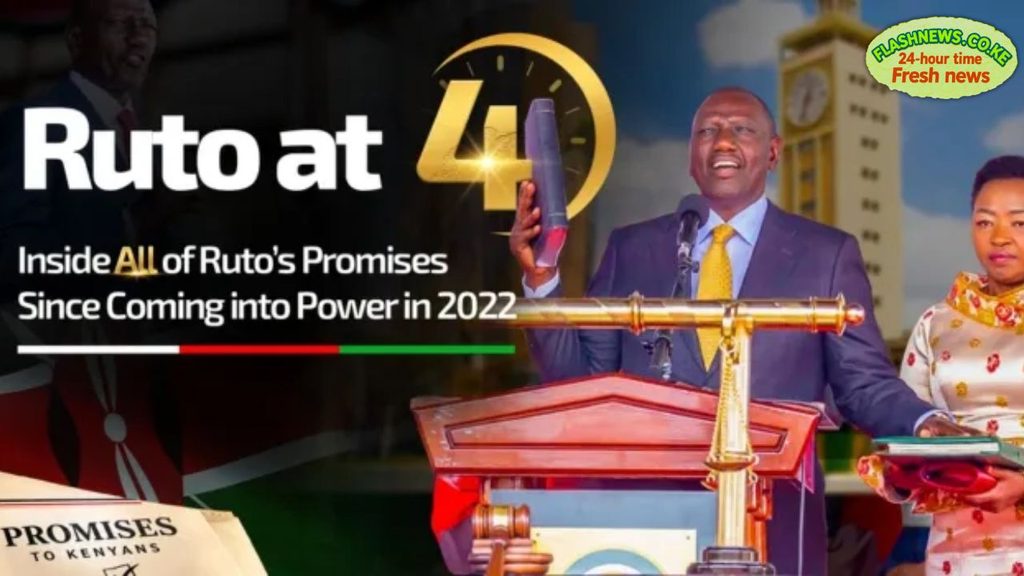
Four years ago, on September 13, 2022, William Ruto was sworn in as Kenya’s fifth President after a fiercely contested election and a campaign built around the promise of a fundamental change in the country’s economic and development model.
At the centre of his agenda was the Bottom-Up Economic Transformation Agenda (BETA), which was presented as the blueprint for lifting millions of Kenyans through job creation, affordable healthcare, improved agricultural production, infrastructure development and a lower cost of living.
But as President Ruto approaches the fourth anniversary of his inauguration, questions are increasingly being raised over how many of those promises have actually been delivered.
An analysis by Kenyans.co.ke examined at least 750 promises and declarations made by President Ruto and members of his Cabinet over the past four years.
Of these, 455 distinct promises and declarations were specifically made by President Ruto himself during public engagements across the country.
The findings show that only 12 of the 455 presidential promises have been fulfilled, while 21 remain under implementation.
A further 422 promises remain unfulfilled, according to the tracker.
One promise has also been classified as abandoned — Ruto’s pledge to establish a quasi-judicial inquiry into state capture within 30 days of assuming office.
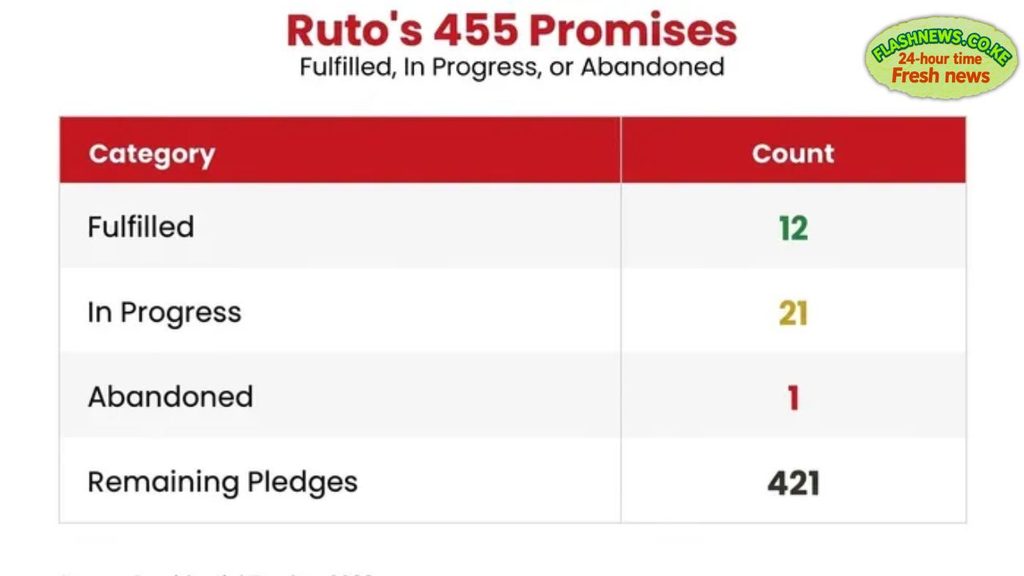
Ruto’s 455 Promises: What Happened to the Rest?
Among the promises still listed as being implemented are some of the administration’s most ambitious commitments.
They include the pledge to plant five billion trees, provide chiefs with digital tablets, take action against rogue police officers, construct a dual carriageway linking Nakuru to Malaba, and introduce various tax reforms.
Some of the commitments were attached to specific deadlines, including 100 days, six months, one year and two years, while others were given timelines stretching beyond 2027.
The review suggests that several deadlines have passed without the corresponding promises being fully realised, while others have either been delayed, altered or overtaken by subsequent government priorities.
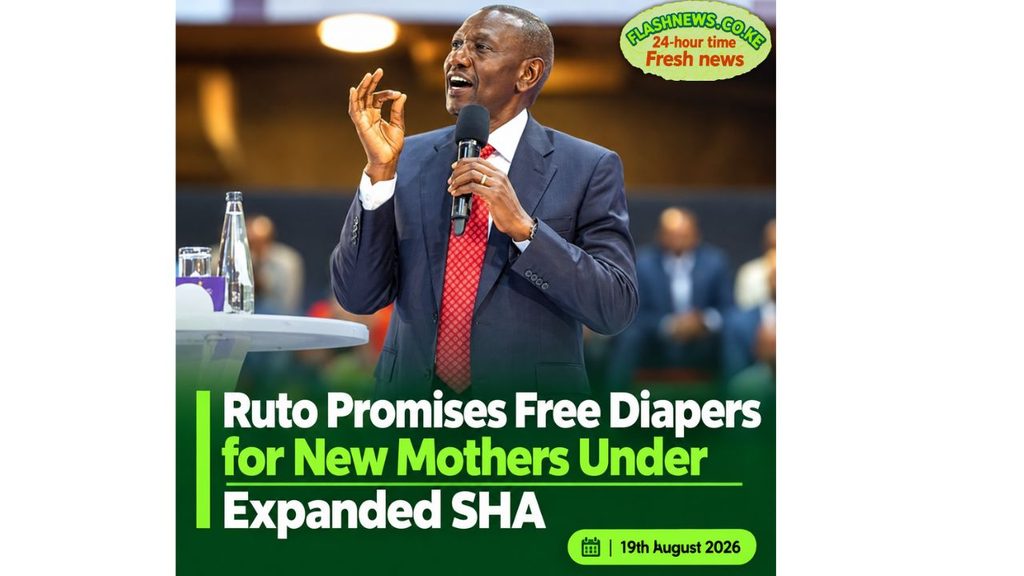
The result is a striking gap between the scale of the promises made in 2022 and the number that have so far been recorded as completed.
Ruto Rejects Claims of Broken Promises
Despite the findings, President Ruto has repeatedly defended his administration’s record and insisted that his government has delivered on the programme presented to Kenyans.
Speaking during his tour of Kericho County on Thursday, September 10, the President dismissed suggestions that his administration had overpromised.
“We have transformed Kenya in accordance with our plan. We never overpromised; we never said what we could not deliver. We have delivered on our commitments,” Ruto said.
The contrasting assessments are likely to fuel debate as the President enters the fourth year of his administration, with Kenyans preparing to judge his record against the promises made during the 2022 campaign.
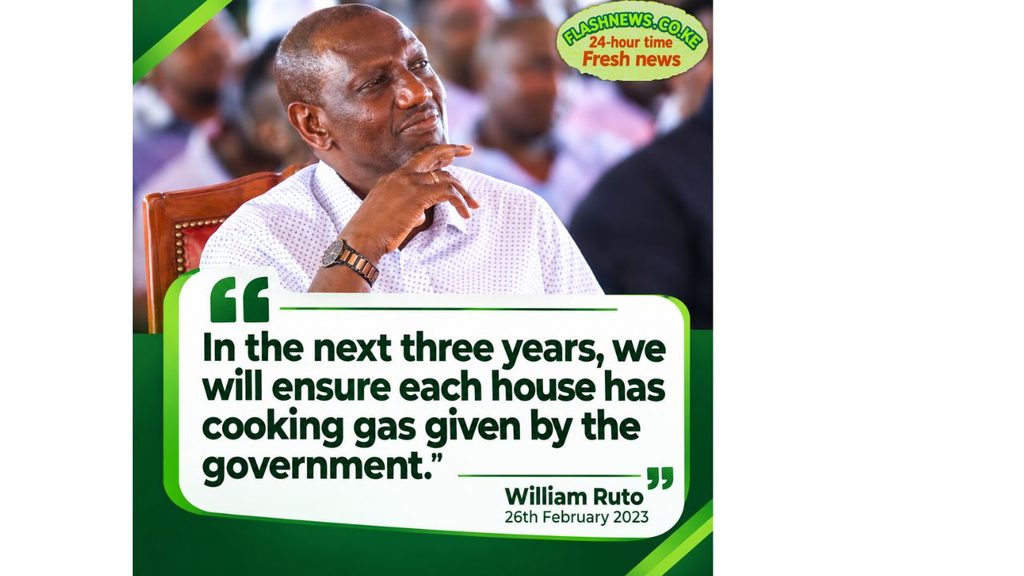
The Cost of Living Test: Fertiliser Down, Unga Promise Still Unmet
One of the most politically sensitive areas of Ruto’s presidency has been the cost of living.
When he took office in September 2022, millions of Kenyans were struggling with soaring food prices, particularly the cost of maize flour, while farmers were facing expensive agricultural inputs.
During his campaign, Ruto promised to reduce the price of unga within his first 100 days in office.
His administration subsequently shifted away from the consumption subsidies used by the previous government and instead focused heavily on supporting agricultural production, particularly through subsidised fertiliser.
Four years later, fertiliser prices have fallen significantly compared with the levels witnessed when Ruto assumed office, but the price of unga remains above the target that featured prominently in his campaign.
That has left one of the administration’s biggest economic promises facing a difficult test: has the government’s agricultural strategy delivered meaningful relief to ordinary households?
Changing weather patterns, droughts and other disruptions to agricultural production have further complicated the government’s efforts to lower food prices.
SHA Under Pressure as Healthcare Promise Faces Reality Check
Healthcare was another major pillar of Ruto’s 2022 campaign.
The President promised to overhaul Kenya’s healthcare system and reduce the financial burden placed on families when they fall ill.
The transition from the National Health Insurance Fund (NHIF) to the Social Health Authority (SHA) has been one of the administration’s biggest reforms.
The government has presented SHA as a major step towards Universal Health Coverage, arguing that the new system will expand access to healthcare and reduce catastrophic medical expenses.
But implementation has been accompanied by controversy.
SHA has faced questions over registration, access to services, hospital payments, outstanding bills and the ability of health facilities to cope with the new system.
The government says the authority has millions of registered members and represents a major transformation of healthcare financing.
Critics, however, continue to ask a more basic question: can ordinary Kenyans now access treatment without turning to harambees, family contributions or personal debt to clear medical bills?
The answer remains central to any assessment of Ruto’s healthcare promise.
Roads and Infrastructure: Big Ambitions, Mixed Progress
Infrastructure was another cornerstone of Ruto’s campaign platform, with the President promising an extensive expansion of Kenya’s road network and other major public projects.
Four years into his administration, several projects have progressed, while others have faced delays, funding constraints or remain at different stages of development.
Among the projects attracting significant attention is the proposed expansion of major highways, including the ambitious Rironi-Mau Summit road corridor.
The administration has also increasingly embraced Public-Private Partnerships (PPPs) as a way of financing major infrastructure projects.
The shift comes at a time when the government is facing constrained public finances, rising debt obligations and limited fiscal space for large-scale development projects.
For the administration, PPPs offer a way of continuing major infrastructure investment without relying entirely on the national budget.
For taxpayers and motorists, however, questions remain over the cost, timelines and eventual financial burden associated with some of these projects.
Four Years, 455 Promises — And a Long Road Ahead
The promise tracker offers a snapshot of an administration whose record is far more complicated than either its supporters or critics may suggest.
While 12 promises have been recorded as fulfilled and 21 remain in progress, the overwhelming majority — 422 — remain outstanding.
The figures do not necessarily mean that every outstanding pledge has been abandoned. Some projects are still under construction, while others have been revised, delayed or given new timelines.
But they provide a measurable way of examining the distance between what was promised and what has actually been delivered.
As Kenya approaches the next general election cycle, the question is no longer simply what President Ruto promised in 2022.
The bigger question is how much of that promise has reached the ordinary Kenyan — and how much remains on paper.
Kenyans.co.ke says its four-day review will examine the administration’s record sector by sector, covering infrastructure, healthcare, education, agriculture and the cost of living before presenting an overall assessment of the President’s four-year record.
For President Ruto, the findings present both a defence of progress already made and a reminder of the considerable list of promises still waiting to be fulfilled.
Inside Ruto’s 455 Promises: Four Years On, Just 12 Fulfilled
President William Ruto came to power promising to transform Kenya’s economy and improve the lives of ordinary citizens. Four years later, a detailed review of his pledges paints a mixed picture — with just 12 of 455 presidential promises recorded as fulfilled.
Four years ago, on September 13, 2022, William Ruto was sworn in as Kenya’s fifth President after a fiercely contested election and a campaign built around the promise of a fundamental change in the country’s economic and development model.
At the centre of his agenda was the Bottom-Up Economic Transformation Agenda (BETA), which was presented as the blueprint for lifting millions of Kenyans through job creation, affordable healthcare, improved agricultural production, infrastructure development and a lower cost of living.
But as President Ruto approaches the fourth anniversary of his inauguration, questions are increasingly being raised over how many of those promises have actually been delivered.
An analysis by Kenyans.co.ke examined at least 750 promises and declarations made by President Ruto and members of his Cabinet over the past four years.
Of these, 455 distinct promises and declarations were specifically made by President Ruto himself during public engagements across the country.
The findings show that only 12 of the 455 presidential promises have been fulfilled, while 21 remain under implementation.
A further 422 promises remain unfulfilled, according to the tracker.
One promise has also been classified as abandoned — Ruto’s pledge to establish a quasi-judicial inquiry into state capture within 30 days of assuming office.
Ruto’s 455 Promises: What Happened to the Rest?
Among the promises still listed as being implemented are some of the administration’s most ambitious commitments.
They include the pledge to plant five billion trees, provide chiefs with digital tablets, take action against rogue police officers, construct a dual carriageway linking Nakuru to Malaba, and introduce various tax reforms.
Some of the commitments were attached to specific deadlines, including 100 days, six months, one year and two years, while others were given timelines stretching beyond 2027.
The review suggests that several deadlines have passed without the corresponding promises being fully realised, while others have either been delayed, altered or overtaken by subsequent government priorities.
The result is a striking gap between the scale of the promises made in 2022 and the number that have so far been recorded as completed.
Ruto Rejects Claims of Broken Promises
Despite the findings, President Ruto has repeatedly defended his administration’s record and insisted that his government has delivered on the programme presented to Kenyans.
Speaking during his tour of Kericho County on Thursday, September 10, the President dismissed suggestions that his administration had overpromised.
“We have transformed Kenya in accordance with our plan. We never overpromised; we never said what we could not deliver. We have delivered on our commitments,” Ruto said.
The contrasting assessments are likely to fuel debate as the President enters the fourth year of his administration, with Kenyans preparing to judge his record against the promises made during the 2022 campaign.
The Cost of Living Test: Fertiliser Down, Unga Promise Still Unmet
One of the most politically sensitive areas of Ruto’s presidency has been the cost of living.
When he took office in September 2022, millions of Kenyans were struggling with soaring food prices, particularly the cost of maize flour, while farmers were facing expensive agricultural inputs.
During his campaign, Ruto promised to reduce the price of unga within his first 100 days in office.
His administration subsequently shifted away from the consumption subsidies used by the previous government and instead focused heavily on supporting agricultural production, particularly through subsidised fertiliser.
Four years later, fertiliser prices have fallen significantly compared with the levels witnessed when Ruto assumed office, but the price of unga remains above the target that featured prominently in his campaign.
That has left one of the administration’s biggest economic promises facing a difficult test: has the government’s agricultural strategy delivered meaningful relief to ordinary households?
Changing weather patterns, droughts and other disruptions to agricultural production have further complicated the government’s efforts to lower food prices.
SHA Under Pressure as Healthcare Promise Faces Reality Check
Healthcare was another major pillar of Ruto’s 2022 campaign.
The President promised to overhaul Kenya’s healthcare system and reduce the financial burden placed on families when they fall ill.
The transition from the National Health Insurance Fund (NHIF) to the Social Health Authority (SHA) has been one of the administration’s biggest reforms.
The government has presented SHA as a major step towards Universal Health Coverage, arguing that the new system will expand access to healthcare and reduce catastrophic medical expenses.
But implementation has been accompanied by controversy.
SHA has faced questions over registration, access to services, hospital payments, outstanding bills and the ability of health facilities to cope with the new system.
The government says the authority has millions of registered members and represents a major transformation of healthcare financing.
Critics, however, continue to ask a more basic question: can ordinary Kenyans now access treatment without turning to harambees, family contributions or personal debt to clear medical bills?
The answer remains central to any assessment of Ruto’s healthcare promise.
Roads and Infrastructure: Big Ambitions, Mixed Progress
Infrastructure was another cornerstone of Ruto’s campaign platform, with the President promising an extensive expansion of Kenya’s road network and other major public projects.
Four years into his administration, several projects have progressed, while others have faced delays, funding constraints or remain at different stages of development.
Among the projects attracting significant attention is the proposed expansion of major highways, including the ambitious Rironi-Mau Summit road corridor.
The administration has also increasingly embraced Public-Private Partnerships (PPPs) as a way of financing major infrastructure projects.
The shift comes at a time when the government is facing constrained public finances, rising debt obligations and limited fiscal space for large-scale development projects.
For the administration, PPPs offer a way of continuing major infrastructure investment without relying entirely on the national budget.
For taxpayers and motorists, however, questions remain over the cost, timelines and eventual financial burden associated with some of these projects.
Four Years, 455 Promises — And a Long Road Ahead
The promise tracker offers a snapshot of an administration whose record is far more complicated than either its supporters or critics may suggest.
While 12 promises have been recorded as fulfilled and 21 remain in progress, the overwhelming majority — 422 — remain outstanding.
The figures do not necessarily mean that every outstanding pledge has been abandoned. Some projects are still under construction, while others have been revised, delayed or given new timelines.
But they provide a measurable way of examining the distance between what was promised and what has actually been delivered.
As Kenya approaches the next general election cycle, the question is no longer simply what President Ruto promised in 2022.
The bigger question is how much of that promise has reached the ordinary Kenyan — and how much remains on paper.
Kenyans.co.ke says its four-day review will examine the administration’s record sector by sector, covering infrastructure, healthcare, education, agriculture and the cost of living before presenting an overall assessment of the President’s four-year record.
For President Ruto, the findings present both a defence of progress already made and a reminder of the considerable list of promises still waiting to be fulfilled.
Inside Ruto’s 455 Promises: Four Years On, Just 12 Fulfilled
President William Ruto came to power promising to transform Kenya’s economy and improve the lives of ordinary citizens. Four years later, a detailed review of his pledges paints a mixed picture — with just 12 of 455 presidential promises recorded as fulfilled.
Four years ago, on September 13, 2022, William Ruto was sworn in as Kenya’s fifth President after a fiercely contested election and a campaign built around the promise of a fundamental change in the country’s economic and development model.
At the centre of his agenda was the Bottom-Up Economic Transformation Agenda (BETA), which was presented as the blueprint for lifting millions of Kenyans through job creation, affordable healthcare, improved agricultural production, infrastructure development and a lower cost of living.
But as President Ruto approaches the fourth anniversary of his inauguration, questions are increasingly being raised over how many of those promises have actually been delivered.
An analysis by Kenyans.co.ke examined at least 750 promises and declarations made by President Ruto and members of his Cabinet over the past four years.
Of these, 455 distinct promises and declarations were specifically made by President Ruto himself during public engagements across the country.
The findings show that only 12 of the 455 presidential promises have been fulfilled, while 21 remain under implementation.
A further 422 promises remain unfulfilled, according to the tracker.
One promise has also been classified as abandoned — Ruto’s pledge to establish a quasi-judicial inquiry into state capture within 30 days of assuming office.
Ruto’s 455 Promises: What Happened to the Rest?
Among the promises still listed as being implemented are some of the administration’s most ambitious commitments.
They include the pledge to plant five billion trees, provide chiefs with digital tablets, take action against rogue police officers, construct a dual carriageway linking Nakuru to Malaba, and introduce various tax reforms.
Some of the commitments were attached to specific deadlines, including 100 days, six months, one year and two years, while others were given timelines stretching beyond 2027.
The review suggests that several deadlines have passed without the corresponding promises being fully realised, while others have either been delayed, altered or overtaken by subsequent government priorities.
The result is a striking gap between the scale of the promises made in 2022 and the number that have so far been recorded as completed.
Ruto Rejects Claims of Broken Promises
Despite the findings, President Ruto has repeatedly defended his administration’s record and insisted that his government has delivered on the programme presented to Kenyans.
Speaking during his tour of Kericho County on Thursday, September 10, the President dismissed suggestions that his administration had overpromised.
“We have transformed Kenya in accordance with our plan. We never overpromised; we never said what we could not deliver. We have delivered on our commitments,” Ruto said.
The contrasting assessments are likely to fuel debate as the President enters the fourth year of his administration, with Kenyans preparing to judge his record against the promises made during the 2022 campaign.
The Cost of Living Test: Fertiliser Down, Unga Promise Still Unmet
One of the most politically sensitive areas of Ruto’s presidency has been the cost of living.
When he took office in September 2022, millions of Kenyans were struggling with soaring food prices, particularly the cost of maize flour, while farmers were facing expensive agricultural inputs.
During his campaign, Ruto promised to reduce the price of unga within his first 100 days in office.
His administration subsequently shifted away from the consumption subsidies used by the previous government and instead focused heavily on supporting agricultural production, particularly through subsidised fertiliser.
Four years later, fertiliser prices have fallen significantly compared with the levels witnessed when Ruto assumed office, but the price of unga remains above the target that featured prominently in his campaign.
That has left one of the administration’s biggest economic promises facing a difficult test: has the government’s agricultural strategy delivered meaningful relief to ordinary households?
Changing weather patterns, droughts and other disruptions to agricultural production have further complicated the government’s efforts to lower food prices.
SHA Under Pressure as Healthcare Promise Faces Reality Check
Healthcare was another major pillar of Ruto’s 2022 campaign.
The President promised to overhaul Kenya’s healthcare system and reduce the financial burden placed on families when they fall ill.
The transition from the National Health Insurance Fund (NHIF) to the Social Health Authority (SHA) has been one of the administration’s biggest reforms.
The government has presented SHA as a major step towards Universal Health Coverage, arguing that the new system will expand access to healthcare and reduce catastrophic medical expenses.
But implementation has been accompanied by controversy.
SHA has faced questions over registration, access to services, hospital payments, outstanding bills and the ability of health facilities to cope with the new system.
The government says the authority has millions of registered members and represents a major transformation of healthcare financing.
Critics, however, continue to ask a more basic question: can ordinary Kenyans now access treatment without turning to harambees, family contributions or personal debt to clear medical bills?
The answer remains central to any assessment of Ruto’s healthcare promise.
Roads and Infrastructure: Big Ambitions, Mixed Progress
Infrastructure was another cornerstone of Ruto’s campaign platform, with the President promising an extensive expansion of Kenya’s road network and other major public projects.
Four years into his administration, several projects have progressed, while others have faced delays, funding constraints or remain at different stages of development.
Among the projects attracting significant attention is the proposed expansion of major highways, including the ambitious Rironi-Mau Summit road corridor.
The administration has also increasingly embraced Public-Private Partnerships (PPPs) as a way of financing major infrastructure projects.
The shift comes at a time when the government is facing constrained public finances, rising debt obligations and limited fiscal space for large-scale development projects.
For the administration, PPPs offer a way of continuing major infrastructure investment without relying entirely on the national budget.
For taxpayers and motorists, however, questions remain over the cost, timelines and eventual financial burden associated with some of these projects.
Four Years, 455 Promises — And a Long Road Ahead
The promise tracker offers a snapshot of an administration whose record is far more complicated than either its supporters or critics may suggest.
While 12 promises have been recorded as fulfilled and 21 remain in progress, the overwhelming majority — 422 — remain outstanding.
The figures do not necessarily mean that every outstanding pledge has been abandoned. Some projects are still under construction, while others have been revised, delayed or given new timelines.
But they provide a measurable way of examining the distance between what was promised and what has actually been delivered.
As Kenya approaches the next general election cycle, the question is no longer simply what President Ruto promised in 2022.
The bigger question is how much of that promise has reached the ordinary Kenyan — and how much remains on paper.
Kenyans.co.ke says its four-day review will examine the administration’s record sector by sector, covering infrastructure, healthcare, education, agriculture and the cost of living before presenting an overall assessment of the President’s four-year record.
For President Ruto, the findings present both a defence of progress already made and a reminder of the considerable list of promises still waiting to be fulfilled.
Also Read: UK Student Visa Applicants Face New Scrutiny Over Large Bank Deposits and Education Gaps