






How Isuzu and CFAO Captured 80% of Kenya’s New Vehicle Sales Market
In a significant reshaping of Kenya’s automotive sector, Isuzu East Africa and CFAO Mobility Kenya have emerged as the undisputed leaders, jointly commanding a dominant 80% share of the country’s new vehicle sales market as of early 2025. This development highlights their strategic prowess amid an overall industry downturn characterized by declining demand and intense competition.
According to recently released data from the Kenya Motor Industry Association (KMIA), Isuzu East Africa has expanded its market share to nearly 50%, fueled by robust sales of commercial vehicles including pick-ups, buses, and trucks. The company registered a remarkable 65.13% increase in unit sales in the first quarter of 2025 compared to the same period in 2024, solidifying its position as the top-selling automaker in the country.
Strategic Dominance in Commercial Vehicles
Isuzu’s success can be traced to its unwavering focus on the commercial segment, which contributed to 74% of its total sales. The brand has long been associated with durable and reliable commercial vehicles, a reputation that continues to resonate with transport operators, logistics companies, and government agencies.
Crucial to this growth has been the company’s acquisition of the UD Trucks franchise, which expanded its product offerings in the medium and heavy commercial vehicle category. Furthermore, Isuzu’s deliberate investment in its nationwide dealership and service network has enhanced customer access to after-sales services, reinforcing brand loyalty and customer retention.
Speaking to industry stakeholders, Isuzu East Africa Managing Director Rita Kavashe noted, “We have focused on the real needs of the market—reliability, affordability, and ease of maintenance. Our expansion strategy is built around understanding and serving the logistics and transport sectors more effectively.”
CFAO Mobility Kenya’s Rise Through Consolidation
Running in close second is CFAO Mobility Kenya, a company that was born from the strategic merger of Toyota Kenya and DT Dobie. This consolidation created a multi-brand powerhouse representing Toyota, Suzuki, Mercedes-Benz, Volkswagen, Hyundai, and Sinotruk under a single umbrella.
By the end of 2024, CFAO had increased its overall market share to 32.7%, up from 27.9% in 2020, marking a steady growth trajectory. In the general vehicle segment, which excludes buses, CFAO achieved a 59% market share, with Toyota models alone contributing 53% of those sales.
A key pillar of CFAO’s growth has been its commitment to local vehicle assembly. The firm invested Ksh 300 million in domestic production facilities that assemble high-demand models such as the Toyota Hilux, Hiace, and Fortuner. This local production not only makes these vehicles more price-competitive but also positions the company as a partner in Kenya’s industrial development agenda.
“The ability to offer locally assembled vehicles gives us a unique edge in pricing and procurement for government and corporate clients,” said CFAO Mobility Kenya Managing Director Arvinder Reel. “It also aligns with the government’s vision to boost local manufacturing and job creation.”
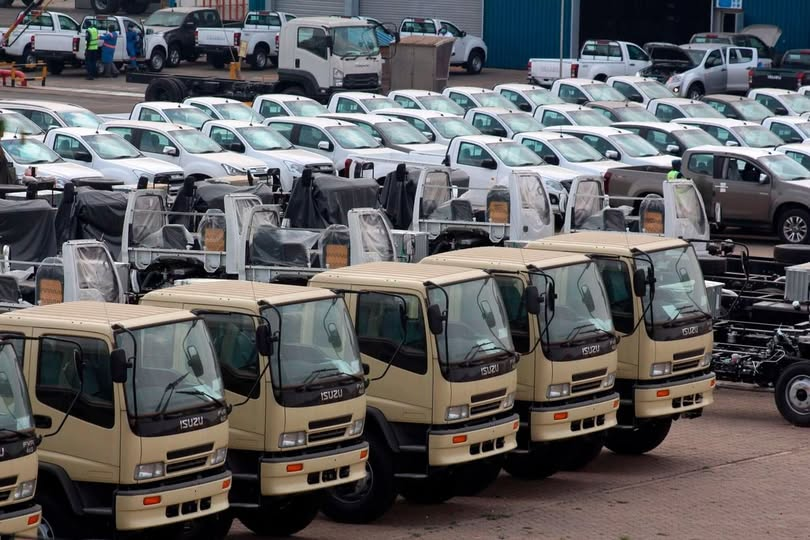
The inclusion of the Sinotruk brand in its lineup has further allowed CFAO to dominate the heavy-duty truck segment, where it now commands 48% of the market share.
Challenges for Other Market Players
While Isuzu and CFAO continue to expand, their ascent has come at the expense of other longstanding automotive firms. Simba Corporation, Tata Africa, and Crown Motors have all reported dwindling sales figures, unable to keep pace with the aggressive growth strategies of the top two players.
Meanwhile, CMC Holdings, once a prominent name in Kenya’s vehicle market, has exited the automotive sales space entirely, redirecting its focus to the agricultural machinery segment. This retreat reflects a broader challenge facing mid-tier players in an increasingly consolidated and competitive market.
A Shrinking Overall Market
Notwithstanding the success of Isuzu and CFAO, Kenya’s overall new vehicle market is in decline. From a peak of 19,253 units sold in 2015, the number of new vehicles registered dropped to just over 10,000 units by November 2024. A combination of economic pressure, high import costs, reduced consumer purchasing power, and limited access to credit has contributed to the contraction.
Despite these headwinds, Isuzu and CFAO’s ability to expand their respective shares underscores their resilience and strategic adaptability. According to KMIA Chairperson Peter Mwangi, “The current market environment is not favorable for many players. However, the top two companies have differentiated themselves through supply chain efficiency, local production, and robust dealership networks.”
Future Outlook: Innovation and Sustainability
Both market leaders are already positioning themselves for the next phase of growth, with strategic plans that align with global trends in mobility and sustainability.
Isuzu East Africa has announced plans to deepen its presence in the transport and logistics sectors, with particular emphasis on solutions for public transport, regional haulage, and last-mile delivery. The company also intends to explore alternative fuel technologies to enhance operational efficiency.
On the other hand, CFAO Mobility Kenya is preparing to venture into the electric vehicle (EV) segment, in line with Toyota’s global pivot toward sustainable mobility. The company is reportedly in early-stage discussions with stakeholders about EV infrastructure development, including charging stations and technician training programs.
This anticipated shift toward electric and hybrid vehicles could reshape Kenya’s automotive market in the coming years, especially as urban centers grapple with traffic congestion and environmental concerns.
Implications for Policy and Industry Development
The concentration of market power in the hands of two players raises important questions for policymakers and industry regulators. On one hand, the scale and efficiency of Isuzu and CFAO support industrialization goals and contribute to formal employment. On the other, the weakening of competition could limit consumer choice and slow innovation in the long term.
Economist Dr. Susan Githinji of the University of Nairobi cautions, “While dominance can drive economies of scale, it is important that regulators monitor market practices to ensure fair competition and avoid monopolistic behaviors.”
As Kenya’s new vehicle market navigates economic challenges and shifting consumer preferences, Isuzu East Africa and CFAO Mobility Kenya have emerged not just as survivors but as architects of a new market reality. Their combined 80% market share is not merely a reflection of sales figures—it is the result of strategic mergers, local investments, operational excellence, and a keen understanding of the evolving needs of Kenyan consumers.
With plans to deepen their presence in core markets and explore sustainable vehicle technologies, the two giants are set to define the future of mobility in Kenya for years to come. The automotive industry, while shrinking in size, may yet be entering a period of qualitative transformation led by innovation, efficiency, and targeted growth strategies.
Also Read: Kenya University Scholarships Delay Puts Future of 208,000 Students at Risk, MPs Warn
How Isuzu and CFAO Captured 80% of Kenya’s New Vehicle Sales Market