


Universities urged to prepare for the first CBC cohort
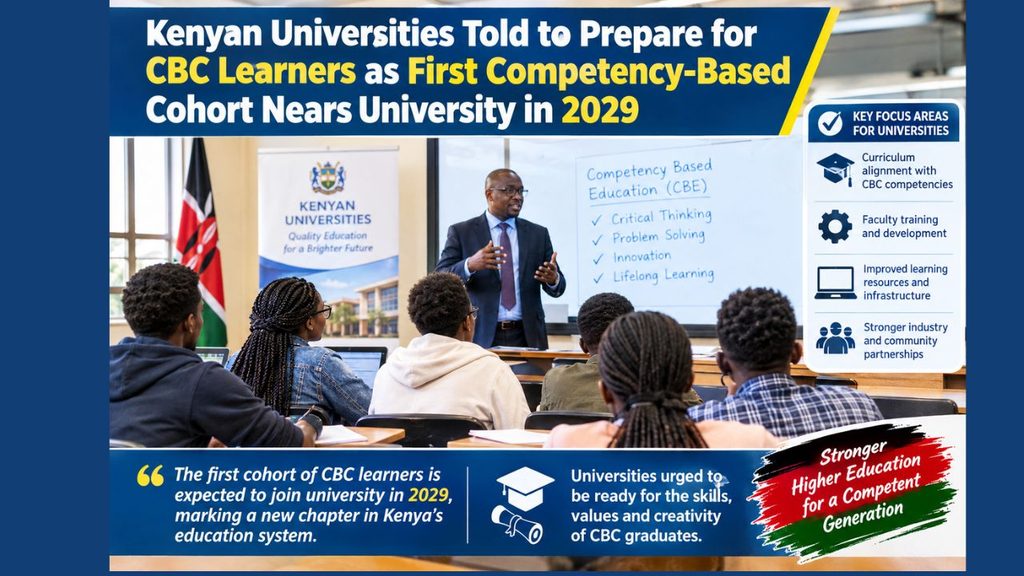
Kenyan universities have been urged to begin preparing for the arrival of learners who have progressed through the Competency-Based Curriculum (CBC), with the first cohort expected to enter university in 2029.
The Commission for University Education (CUE) reported on 22 October 2026 that university leaders had been encouraged to prepare for the transition to Competency-Based Education (CBE) in higher education. The discussion took place during a conference organised by CUE in collaboration with the United States International University-Africa (USIU-Africa).
The meeting gave university leaders an opportunity to examine and contribute to a draft framework intended to guide the transition. The process is significant because learners progressing through the school system may arrive at university with educational experiences and learning needs that differ from those of previous cohorts.
The development is likely to interest parents, teachers, secondary school learners, university administrators and policymakers preparing for changes in higher education.
Official source: Commission for University Education — Universities urged to prepare for the first CBE cohort.
Why 2029 is an important year for higher education
The expected arrival of the first CBC cohort at university in 2029 creates a transition point for institutions that need to consider how their programmes, teaching methods and student support systems will respond to learners progressing through the new curriculum.
CBC has placed greater emphasis on competencies, application of knowledge and the development of skills. The transition into higher education therefore raises questions about how universities will recognise and build on the learning experiences students bring from school.
The change is not simply about revising course documents. Universities may need to review how they teach, assess learning, support students and prepare graduates for employment or further study.
However, the detailed arrangements remain subject to the relevant policy and implementation processes. The draft framework discussed by university leaders should not be described as a fully implemented national policy unless CUE or the Ministry of Education confirms that status.
What is the proposed CBE framework for universities?
The Commission for University Education has been facilitating discussions on a draft Competency-Based Education framework for university education.
According to CUE, the conference was intended to allow university leaders to examine the draft, suggest improvements and contribute to the process before implementation.
The discussions reflect a broader question facing higher education: how can universities prepare graduates who are able to apply knowledge, solve problems, communicate effectively and respond to changes in the workplace?
CUE’s report highlights the need for graduates to demonstrate critical and creative thinking, interdisciplinary collaboration, responsible use of technology and ethical leadership.
These goals would require universities to consider how learning outcomes are defined and assessed, how teaching staff are supported and how programmes remain relevant to changing economic and social needs.
The framework is still part of a consultation and development process described in the Commission’s report. Students and institutions should look for subsequent official announcements before assuming that every proposal has been adopted.
How competency-based learning differs from a narrow focus on memorisation
Competency-based learning focuses on what learners can demonstrate in addition to what they can recall.
In practice, this may involve applying knowledge to a problem, carrying out a task, evaluating evidence, developing a solution or communicating findings effectively. The exact approach depends on the programme, subject and learning outcomes.
For universities, the challenge is to ensure that academic depth is maintained while students develop practical and transferable skills.
A competency-based approach does not mean that theoretical knowledge becomes unnecessary. Students still need strong foundations in their disciplines. The aim is to connect that knowledge with the ability to use it appropriately.
For example, a science student may need to understand scientific principles and apply them to an investigation. An information technology student may need to understand computing concepts and use them to solve a technical problem. A student studying business may need to understand management theory and demonstrate how it applies to a real organisational situation.
These are illustrative examples rather than a list of requirements imposed by the draft framework.
What universities may need to prepare before 2029
CUE’s report identifies several challenges associated with the transition, including financing, staff capacity, infrastructure, technology, assessment methods and institutional culture.
Universities may therefore need to review a number of areas as the framework develops.
1. Curriculum and programme review
Institutions may need to examine how their programmes describe learning outcomes and how students demonstrate achievement of those outcomes.
Programme review should consider the knowledge, skills and professional competencies students are expected to develop. Any changes must follow the applicable regulatory and university approval processes.
2. Staff development
Teaching staff may need support in designing learning activities, assessing competencies and giving students feedback that helps them improve.
Training and professional development can help lecturers understand how to connect academic content with practical application without weakening the standards expected in higher education.
3. Assessment methods
Universities may need to examine whether their assessment approaches provide sufficient evidence of student learning.
Depending on the course, assessment can include examinations, projects, practical demonstrations, presentations, research, portfolios or other approved methods. The appropriate approach should be determined by the programme and its learning outcomes rather than by adopting one method for every subject.
4. Technology and infrastructure
Some forms of teaching and assessment require access to laboratories, specialist equipment, digital learning platforms, libraries or other facilities.
Institutions will need to consider their existing resources and identify gaps that may affect their ability to support new approaches to learning.
5. Student support
Students entering university may need guidance on academic expectations, independent learning, research, digital resources and the demands of their chosen programmes.
Universities can use transition support, academic advising and other services to help learners adapt to higher education.
These areas are reasonable preparation priorities, but the exact requirements will depend on the final framework and subsequent official guidance.
What the transition means for parents and secondary school learners
Parents and learners should understand that the 2029 transition is a reason to follow official education updates, not a reason to panic or assume that university admission rules have already changed.
Learners should continue concentrating on their current schoolwork and follow the instructions provided by their teachers and the Ministry of Education.
Students should also develop useful habits such as reading widely, solving problems, communicating clearly, using digital resources responsibly and applying what they learn. These skills are valuable across different education systems, although the specific expectations for university entry must be confirmed through official admissions information.
Parents should avoid relying on social media posts claiming that new university entry grades, course requirements or admissions procedures have been finalised unless those claims are supported by an official announcement.
Will university admission requirements change in 2029?
CUE’s report concerns preparation for competency-based higher education and the development of a framework. It does not, by itself, establish a complete set of new university admission grades or guarantee changes to every course’s entry requirements.
Admission criteria and programme-specific requirements should be checked through the relevant official channels when they are published.
Learners approaching university should continue to consult the Kenya Universities and Colleges Central Placement Service (KUCCPS), the universities they are interested in and other relevant authorities for confirmed information on admissions, courses and placement procedures.
Useful official links include:
- Commission for University Education
- Kenya Universities and Colleges Central Placement Service
- Ministry of Education
Challenges universities could face
CUE has acknowledged that preparing for competency-based higher education will require resources and institutional changes.
Financing is one challenge because changes to curriculum, teaching and assessment may require investment in facilities, equipment, technology and staff development.
Another challenge is consistency. Universities offer different programmes and operate in different contexts, so institutions will need to consider how a national framework can guide transition while respecting the requirements of individual disciplines.
Staff capacity is also important. A framework will have limited impact if institutions do not provide educators with the time, training and resources needed to implement it effectively.
Finally, universities will need to communicate clearly with learners, parents, employers and other stakeholders so that changes are understood and expectations remain realistic.
Frequently asked questions
When is the first CBC cohort expected to join university?
The first cohort of learners shaped by CBC is expected to enter university in 2029, according to CUE.
Has CUE published a framework for competency-based university education?
CUE has reported on consultations concerning a draft framework. Readers should check the Commission’s latest announcements to establish its current status and any approved implementation arrangements.
Will university admission grades automatically change in 2029?
The cited announcement does not establish new admission grades. Students should rely on official admissions and placement guidance.
What should current secondary school learners do?
They should continue following their current curriculum and school instructions while keeping track of official announcements about higher education.
Which organisation is leading the framework discussions?
The Commission for University Education has been facilitating the development and consultation process in collaboration with USIU-Africa and university stakeholders.
Conclusion
Kenyan universities are being urged to prepare for the first cohort of CBC learners expected to enter higher education in 2029. The discussion around a proposed Competency-Based Education framework raises important questions about curriculum, assessment, staff development, technology and student support.
For parents and learners, the key message is to follow verified announcements rather than assume that every proposed change has already become policy. For universities, the next steps will depend on the development of the framework and the official guidance that follows.
Also Read: Kiirua TTI Orders Mandatory Portfolio Verification Ahead of November/December 2026 Exams