


Kiirua TTI announces mandatory portfolio verification
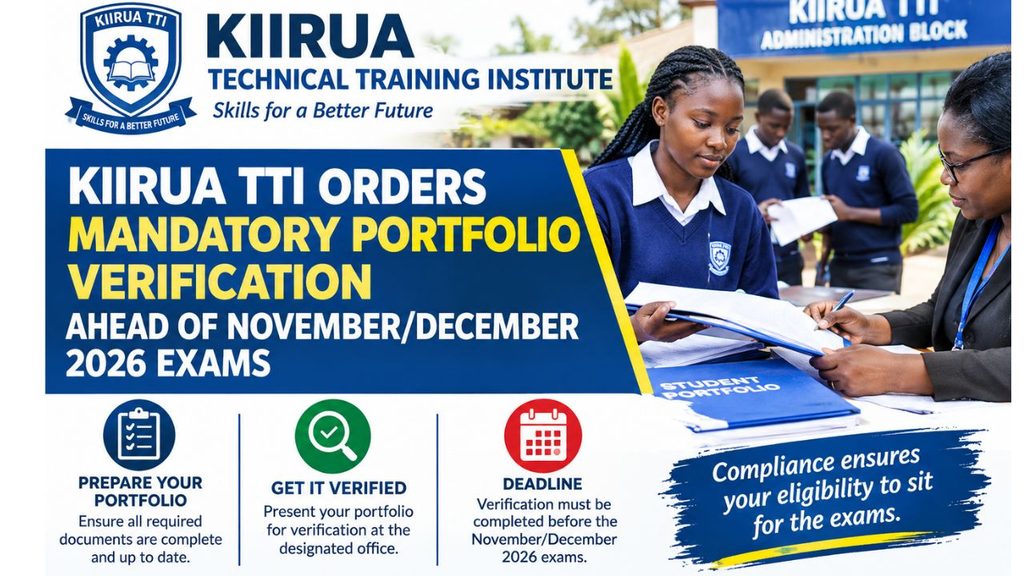
Kiirua Technical Training Institute in Meru County has directed trainers and trainees to prepare for a mandatory Portfolio of Evidence (PoE) verification exercise ahead of the November/December 2026 examination series.
According to a report published by Education News on 26 October, the institute’s Competency-Based Education and Training (CBET) office issued an internal directive setting the exercise for Monday, 2 November, to Friday, 6 November 2026.
The reported schedule states that verification will take place daily from 8:30 a.m. to 4 p.m. in Room X. Trainers and trainees covered by the internal memorandum are expected to follow the institute’s instructions.
The notice is an institution-specific update. It should not be presented as a nationwide order applying automatically to every TVET college in Kenya.
Read the report: Education News — Kiirua TTI announces mandatory portfolio verification ahead of exams.
What is a Portfolio of Evidence?
A Portfolio of Evidence is a collection of records or work samples used to demonstrate a learner’s progress and achievement of specified competencies.
In competency-based training, assessment is concerned with whether learners can demonstrate the knowledge and practical skills required for their programmes. Depending on the course and the applicable assessment rules, evidence may include practical tasks, project work, records of completed activities, assessment forms or other approved material.
The precise documents required are not necessarily the same for every course. Trainees should therefore follow their trainer’s instructions and the requirements for their own programme instead of relying on a generic checklist.
A portfolio should contain genuine evidence of the learner’s work. Trainees should not invent activities, copy another person’s work or alter records to make their progress appear different from what actually occurred.
Why Kiirua TTI is conducting the verification exercise
Portfolio verification can help trainers and institutions establish whether the required evidence has been assembled and whether it is ready for review under the relevant assessment arrangements.
For trainees preparing for the November/December examination series, the exercise provides an opportunity to identify missing records or other issues that need attention before the next stage of assessment.
The process may also help trainers ensure that documentation is organised and that candidates understand the requirements applicable to their programmes.
The published report identifies the verification exercise as mandatory under the institute’s internal directive. Trainees and trainers should therefore consult the memorandum and any subsequent instructions issued by Kiirua TTI for the exact scope of the exercise.
What trainees should prepare before verification
Trainees should begin by reviewing the instructions from their trainers and checking that their portfolios are organised according to the requirements of their specific courses.
Useful preparation steps include:
- Review the list of required evidence provided by the trainer.
- Arrange portfolio documents in the order requested.
- Check that records clearly identify the relevant learner and course.
- Ensure that practical work and other evidence are genuine and complete.
- Identify missing documents or tasks and ask the trainer how to address them.
- Keep any required originals or supporting records available for verification.
- Confirm the time and venue with the relevant department before attending.
This is general preparation advice, not a substitute for the institute’s official checklist. Trainees should not assume that every item above is mandatory for every course.
If a learner has lost a document or is unsure whether a piece of evidence meets the requirements, the best course is to contact the trainer early. Trying to create replacement records without guidance may lead to further problems.
What trainers should do
Trainers should communicate the requirements clearly and ensure that trainees understand what they need to present.
They should also check their own assessment records and follow the institute’s instructions on verification. Where a portfolio contains missing or incomplete evidence, trainers should explain the appropriate next step in line with the programme requirements.
The verification exercise should be approached as a formal assessment-related process. Trainees should attend as instructed, while trainers should maintain accurate records and handle learner information appropriately.
How the exercise relates to CBET
Competency-Based Education and Training focuses on demonstrated ability rather than relying only on theoretical knowledge. A learner may need to show that they can carry out particular tasks, apply technical knowledge or meet specified occupational standards.
The evidence used in this process depends on the programme. A practical course may require evidence of hands-on tasks, while another programme may have different documentation and assessment requirements.
Portfolios can support the recording and review of evidence, but learners must follow the assessment framework that applies to their course. Completing a portfolio does not automatically guarantee a pass; the evidence must meet the relevant requirements and be assessed through the approved process.
Is the verification exercise taking place across all Kenyan TVET colleges?
The report concerns Kiirua Technical Training Institute. It does not establish that every technical training institution has been directed to conduct the same exercise on the same dates.
Other institutions may have their own schedules and instructions. Trainees elsewhere should contact their colleges and consult the relevant assessment authority rather than assume that Kiirua TTI’s internal timetable applies to them.
This distinction is important for accurate education reporting. Flash News should clearly identify the institution involved and avoid presenting a local memorandum as a national directive.
Frequently asked questions
When will Kiirua TTI conduct portfolio verification?
The reported dates are 2–6 November 2026, from 8:30 a.m. to 4 p.m. daily.
Where will the verification take place?
The report identifies Room X at the institute. Trainees should confirm the venue with their departments in case further instructions are issued.
What is a Portfolio of Evidence?
It is a collection of approved records or work samples used to demonstrate learning and competencies.
Is the directive applicable to every TVET college?
The reported notice concerns Kiirua TTI. Other colleges should follow their own official instructions.
What should trainees do if their portfolios are incomplete?
They should contact their trainers promptly and follow the guidance given for their specific programmes.
Conclusion
Kiirua Technical Training Institute’s planned portfolio verification is an important reminder for affected trainees to prepare their assessment records before the November/December 2026 examination series.
Trainees should review their course requirements, organise genuine evidence and confirm the arrangements with their trainers. The institute’s internal memorandum remains the primary source for the exercise’s exact requirements.
Also Read: KNEC Releases July 2026 Business and Technical Examination Results: December 7 Deadline for Queries