

CS Geoffrey Ruku Hits Back at Mt Kenya ‘Division’ Claims: ‘I Am Just Telling the Truth’





Public Service Cabinet Secretary Geoffrey Ruku has rejected accusations that he is trying to split Mt Kenya, insisting his controversial remarks are about correcting what he describes as years of unequal development and political representation.
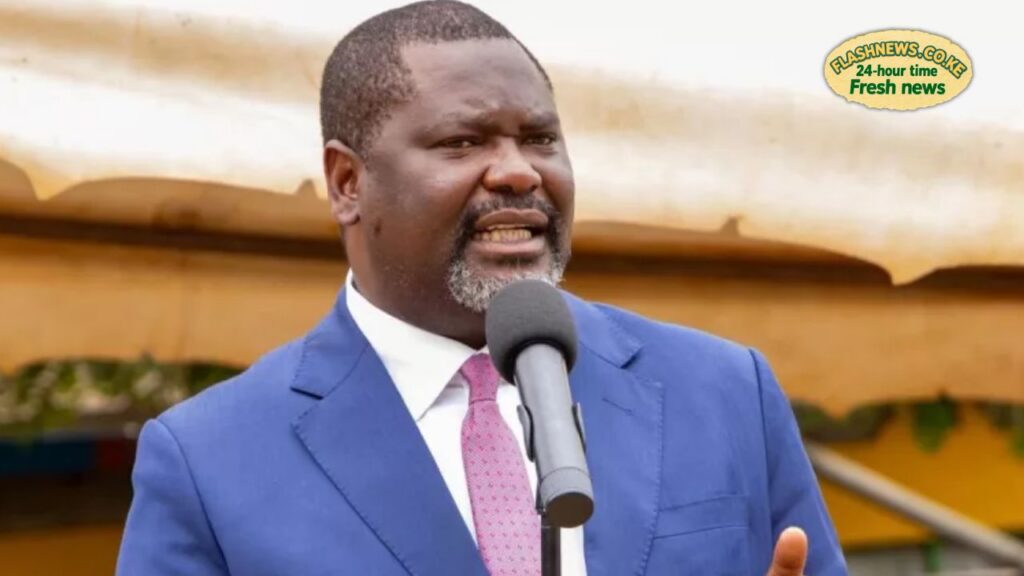
Ruku said he was not seeking to create a new fault line within the region but was instead drawing attention to disparities that, in his view, have been overlooked for years.
Speaking during an interview with NTV, the Cabinet Secretary pushed back against criticism of his campaign for greater recognition of Mt Kenya East.
“I am not splitting the mountain. I am just saying the truth of how things are as far as the region is concerned,” Ruku said.
His comments come amid an increasingly heated debate over the political and economic relationship between Mt Kenya East, comprising Meru, Embu and Tharaka Nithi, and Mt Kenya West, which includes counties such as Kiambu, Murang’a, Nyeri and Kirinyaga.
Ruku insisted that the communities of the wider Mt Kenya region have historically shared a common political journey.
“We fought for the independence of the country together as the mountain. We have been in government together in past regimes and even this administration,” he said.
However, he argued that shared history should not prevent residents from questioning whether development and government opportunities have been distributed fairly.
Ruku points to roads and electricity
The CS singled out infrastructure as evidence of what he described as a longstanding imbalance.
He claimed that the majority of roads constructed in the wider Mt Kenya region are concentrated on the western side.
“If you look at the distribution of infrastructure, roads in Mt Kenya, the number of kilometres of tarmacked roads, you will find 77.7 per cent of all the roads constructed in Mt Kenya region are in Mt Kenya West,” he said.
Ruku also pointed to electricity connectivity, contrasting Kiambu with Tharaka Nithi.
“In Kiambu County, electricity connection is about 90 per cent. But in Tharaka Nithi County, you will ask yourself, are we in the same region?” he posed.
The figures form part of Ruku’s broader argument that Mt Kenya East should have a stronger voice when development priorities and political interests are being negotiated.
In a separate recent appearance, Ruku similarly claimed that about 77.7 per cent of road development funds allocated to the wider Mt Kenya region had gone to the western counties, leaving 23.3 per cent for Meru, Embu and Tharaka Nithi.
‘This perpetual unfair treatment has to come to an end’
Ruku maintained that his argument should not be interpreted as hostility towards Mt Kenya West.
Instead, he said, the focus should be on addressing what he regards as historical inequalities.
“This perpetual unfair treatment is what I say has to come to an end,” Ruku said.
The Cabinet Secretary has increasingly championed the interests of Mt Kenya East, arguing that Meru, Embu and Tharaka Nithi should not automatically follow the political direction set by Mt Kenya West.
His position has, however, generated controversy within government and across the region.
Ruku has previously called for a political separation between the two sides of Mt Kenya, saying Mt Kenya East should chart its own political course if its interests are not being adequately represented. Those remarks triggered criticism from Energy Principal Secretary Alex Wachira, who warned against rhetoric that could deepen divisions within the region.
A political battle with 2027 in sight
The dispute is unfolding less than a year before Kenya’s 2027 General Election, giving Ruku’s comments a potentially significant political dimension.
Mt Kenya has traditionally been regarded as an important electoral bloc, and any shift in political alliances between its eastern and western sections could have consequences for national politics.
Ruku has argued that Mt Kenya East has repeatedly supported political interests associated with Mt Kenya West without receiving comparable development benefits or political influence.
“We, the people from Mt Kenya East, have supported Mt Kenya West time and again,” he said.
The debate therefore goes beyond the question of whether the region should remain politically united.
For Ruku, the central issue is whether unity should continue to mean a single political voice—or whether Mt Kenya East should demand a stronger and more independent voice in determining where development resources go and which political interests it supports.
His critics, meanwhile, see the rhetoric as potentially deepening regional divisions at a politically sensitive moment.
With the 2027 election approaching, the increasingly public disagreement could become one of the key battles shaping Mt Kenya’s political direction.
Also Read: 100-Year-Old Trees Are Being Cut’: Sakaja Issues Stark Nairobi Warning