






Whistleblower Nelson Amenya Alleges Secret Redesign, Foreign Printing of Kenyan Currency
Prominent whistleblower Nelson Amenya, who previously exposed the controversial Adani-JKIA airport deal, has once again stirred public discourse—this time with claims that the Kenyan government has secretly redesigned the national currency and contracted a German company to print it without public knowledge or participation.
Amenya, widely known for leveraging social media to raise political and financial red flags, made the allegations on his X (formerly Twitter) account early Monday morning. According to the activist, the new currency is already undergoing mass production in Germany in what he described as a non-transparent and potentially illegal arrangement.
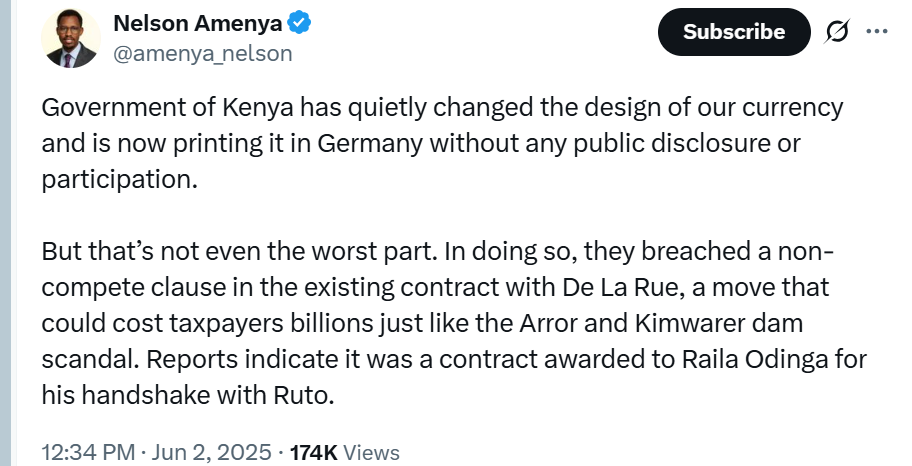
“The Government of Kenya has quietly changed the design of our currency and is now printing it in Germany without any public disclosure or participation,” Amenya posted.
This revelation comes amid heightened scrutiny of the Central Bank of Kenya (CBK), which had previously acknowledged that it had contracted a German firm for currency printing. However, CBK Governor Dr. Kamau Thugge, during a press briefing in August 2024, did not disclose that the currency design had also been changed.
“The printing is being done by a German firm, and it is actually one of the best firms,” Dr. Thugge said at the time, framing the decision as a routine replacement of worn-out notes.
Yet, no public statement or parliamentary briefing has been made to confirm or explain a full redesign of Kenya’s banknotes since the last security upgrade in 2024. The lack of public consultation or transparency surrounding such a significant national decision has sparked alarm among watchdogs, economists, and opposition voices.
Adding further intrigue, Amenya claimed the secret deal violated an existing agreement with De La Rue, the British-based security printing firm that had partnered with the Kenyan government in a joint venture since 1993. The deal allegedly included a non-compete clause barring Kenya from engaging other printers for currency production.
“But that’s not even the worst part,” Amenya continued in his post. “In doing so, they breached a non-compete clause in the existing contract with De La Rue, a move that could cost taxpayers billions, just like the Arror and Kimwarer dam scandal. Reports indicate it was a contract awarded to Raila Odinga for his handshake with Ruto.”
The explosive suggestion that the currency printing contract was offered as a political reward to Raila Odinga, a long-standing opposition leader now cooperating with President William Ruto’s government, has only added fuel to the controversy.
De La Rue, once employing over 300 staff in Kenya, began scaling down its operations in 2023 and exited its joint venture with the government, citing diminished demand for banknotes and security printing. The firm reportedly spent over Ksh2.7 billion in legal fees, severance packages, and asset write-offs during the exit process.
This is not the first time Kenya’s currency printing process has attracted attention. In 2018, the High Court dismissed an attempt by De La Rue and another firm to block CBK from opening tender bids, setting a precedent for competitive sourcing. However, critics argue that competitive bidding does not excuse the lack of transparency in the most recent changes.
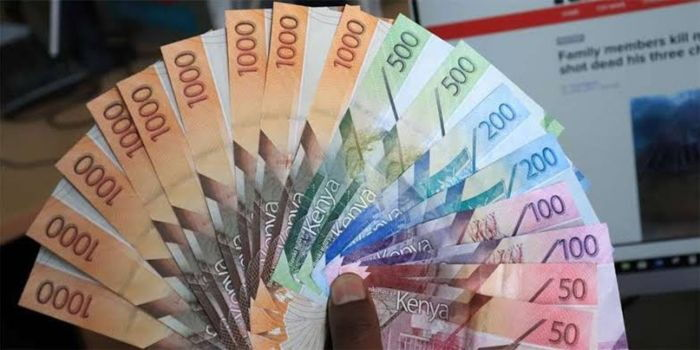
According to recent disclosures by CBK to Parliament, printing has indeed begun in Germany under the firm Giesecke+Devrient Currency Technology GmbH (G+D), which specializes in banknote and security technology. Despite this, CBK has not responded to the renewed public concerns regarding design alterations or possible contract violations.
Legal experts suggest that if De La Rue’s contract was still legally binding at the time of the switch, Kenya could face litigation, penalties, or arbitration, further burdening taxpayers.
As calls grow for full disclosure, Parliament is expected to summon CBK officials for a formal inquiry. Meanwhile, civil society groups have demanded the release of the new currency design and all associated procurement documents.
With public trust on the line and questions surrounding legality and ethics mounting, the government faces mounting pressure to clarify the motives and implications of its latest move on the national currency.
Also Read: Fred Matiang’i Hints at 2027 Presidential Run with Jubilee-Endorsed Campaign Launch
Whistleblower Nelson Amenya Alleges Secret Redesign, Foreign Printing of Kenyan Currency