






PHOTOS: Inside the New Raila Odinga Mausoleum as KDF Begins Two-Month Race to Complete Landmark Project
The Kenyan government has unveiled ambitious plans for the construction of the Raila Odinga Mausoleum, with the Kenya Defence Forces (KDF) expected to spearhead the project in what officials describe as a fast-tracked two-month construction programme once site surveys are completed.
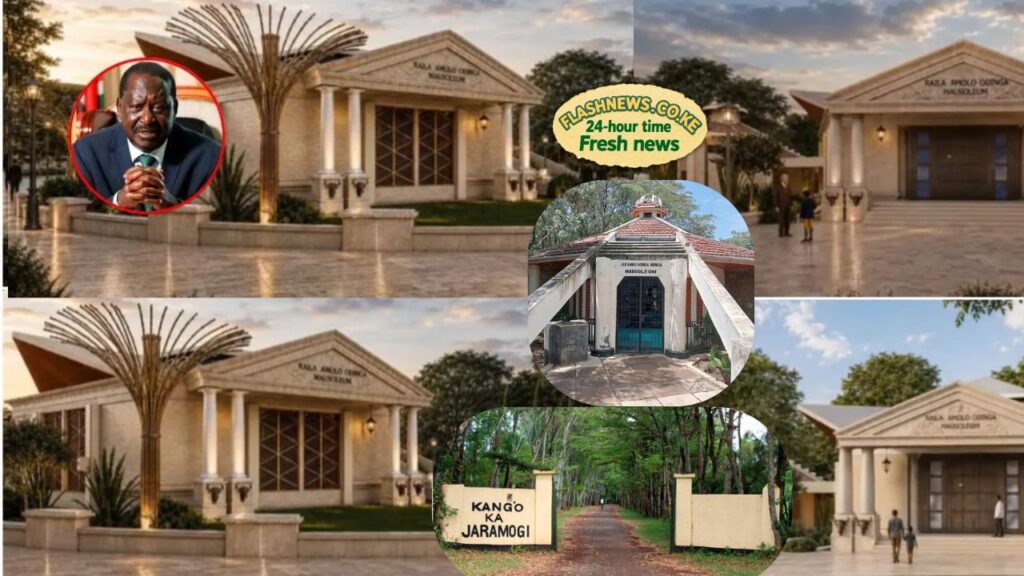
The mausoleum, which will stand alongside the historic Jaramogi Oginga Odinga Mausoleum at Kang’o Ka Jaramogi in Bondo, is expected to become one of Kenya’s most significant heritage landmarks, preserving the legacy of one of the country’s most influential political figures while expanding the existing museum complex.
The timeline was confirmed on Monday, July 20, during the official handover of the construction site by Defence Cabinet Secretary Soipan Tuya, who presided over the event attended by senior government officials, representatives of the National Museums of Kenya, and members of the Odinga family.
The project forms part of a broader government initiative aimed at transforming the site into a national heritage destination that combines remembrance, education, historical research and cultural tourism.
Pentagonal Design Inspired by Symbolism
During the ceremony, the National Museums of Kenya officially unveiled the architectural designs through Chief Architect Sanso Malaki, revealing a striking departure from the existing mausoleum built in 1995.
Unlike the hexagonal design of the late Jaramogi Oginga Odinga Mausoleum, Raila Odinga’s final resting place will adopt a distinctive pentagonal structure, a concept architects say symbolises strength, unity and collective purpose.
According to Malaki, the symbolism extends throughout the building.
“The number five has been intentionally incorporated into the entire design concept,” the architect explained during the public presentation.
Five descending steps will lead visitors to the grave itself, while the monument has been carefully planned to reflect harmony and continuity between the two generations of the Odinga family.
The two mausoleums will stand approximately eight metres apart, linked by a landscaped pedestrian walkway allowing visitors to move seamlessly between both memorials.
Digital Museum, QR Codes and Research Centre
Beyond serving as a burial site, the Raila Odinga Mausoleum is being designed as an interactive historical centre.
Architects revealed that visitors will encounter mini exhibition galleries lining the interior walls, documenting Raila Odinga’s political journey, public service and contribution to Kenya’s democratic development.
A QR-code digital archive will also be installed throughout the facility, allowing visitors to access detailed historical records, photographs, speeches and other educational material using their mobile devices.
The master plan further includes accommodation for researchers studying Kenya’s political history, enabling scholars to conduct long-term fieldwork directly from the site.
In addition, planners have incorporated a modern conference centre and an amphitheatre, facilities expected to host public lectures, cultural festivals, academic forums and heritage exhibitions throughout the year.
Designed for Growing Visitor Numbers
Officials say improving visitor experience formed a central part of the planning process.
The National Museums of Kenya estimates that the existing museum already receives more than 1,000 visitors every week, with the upgraded facility expected to attract significantly larger numbers.
To accommodate this, the entire compound has been redesigned with wider walkways, improved accessibility and enhanced visitor movement.
A four-metre clearance surrounding the grave will allow mourners and tourists to walk comfortably around the monument.
The development will also feature extensive landscaping, upgraded signage and two ceremonial entrance gates marking both the historic entrance and the new access point.
Jaramogi Mausoleum to Receive Major Facelift
The construction project extends beyond the new mausoleum.
Government planners confirmed that the existing Jaramogi Oginga Odinga Mausoleum, now approaching three decades since its construction, will undergo extensive renovation works to modernise and restore the landmark.
According to the master plan, both mausoleums will become the focal point of a circular visitor pathway designed to ensure smooth movement through the heritage site.
Architects said the arrangement deliberately mirrors the traditional layout of a Luo homestead, allowing visitors to first pay tribute to Jaramogi Oginga Odinga before proceeding to the Raila Odinga Mausoleum.
Some existing structures within the compound will be removed to create adequate space for the expanded development.
KDF to Lead Construction
The entire project will be executed by the Kenya Defence Forces, with Defence CS Soipan Tuya confirming that the military engineering teams will oversee construction after government survey work is completed.
Officials estimate the works will take approximately two months, making it one of the fastest heritage infrastructure projects undertaken by the government in recent years.
Once completed, the expanded complex is expected to serve not only as a place of remembrance but also as a centre for education, historical research and cultural preservation for future generations.
Also Read: DPP Tells Court Albert Ojwang Was Tortured in Police Custody Before CCTV Footage Was Deleted