






Former Deputy President Rigathi Gachagua’s legal team has launched a fresh attack on the process that led to his impeachment, claiming Parliament orchestrated a flawed and unconstitutional exercise designed to lock out ordinary Kenyans from participating.

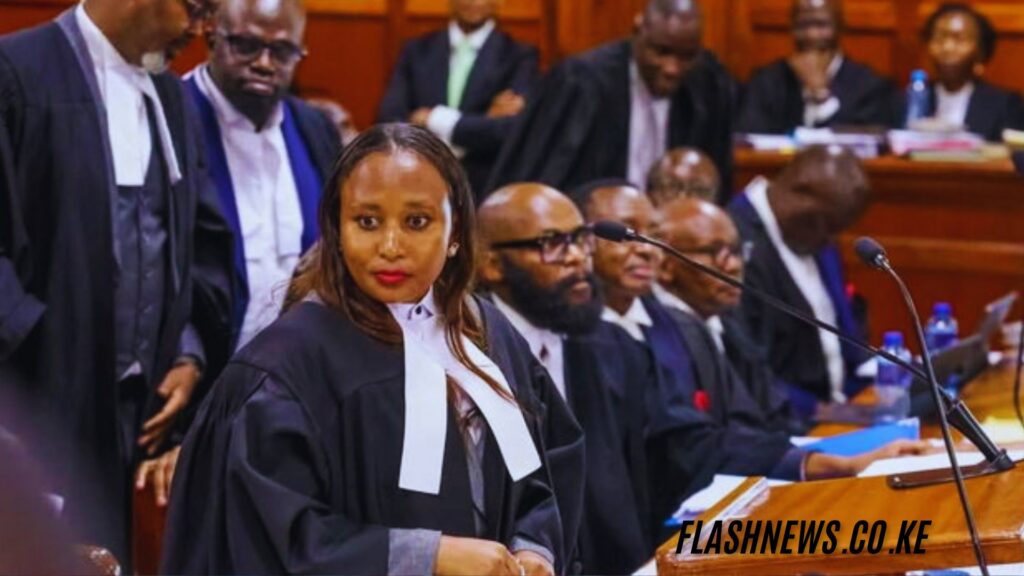
Appearing before a three-judge bench on Thursday, May 8, lawyer Njeri Maina argued that the impeachment proceedings were marred by glaring procedural irregularities and failed to satisfy constitutional requirements on public participation.
Maina told the court that the process was “planned, intentional and orchestrated,” insisting that several constituencies were effectively excluded from taking part in the exercise.
According to the lawyer, the petition before the court revolves around three major constitutional questions: what constitutes adequate public participation, what qualifies as reasonable notice, and how both qualitative and quantitative participation should be measured under the Constitution.
“There was systematic exclusion in various constituencies. Some of the offices remained closed. This was not accidental. It was intentional, it was planned, and it vitiated the adequacy of the process and its outcome,” Maina submitted before the bench.
The submissions form part of an ongoing legal battle seeking to overturn the dramatic impeachment of Gachagua, whose fallout with sections of the Kenya Kwanza administration triggered one of the most consequential political crises in recent Kenyan history.
Maina further faulted the National Assembly over the timing of the public participation notice, telling the judges that the Gazette Notice announcing the exercise was published on October 5, 2024 — the very day public participation was allegedly conducted.
“I submit that a public gazette was issued on the 5th of October 2024, and subsequently on the same day, a public participation was undertaken,” she argued.
The lawyer maintained that Kenyans were denied meaningful participation because Parliament failed to conduct civic education ahead of the exercise. She argued that members of the public were not provided with explanatory materials or guidance on how to complete participation templates.
In a direct challenge to Parliament, Maina also criticised the National Assembly’s reliance on Standing Order 64(2) to fast-track the impeachment proceedings.
She argued that parliamentary standing orders cannot override constitutional provisions, particularly Articles 10 and 118, which enshrine public participation as a national value and legislative requirement.
Citing a previous High Court ruling involving the Orange Democratic Movement (ODM) and the Speaker of the National Assembly, Maina insisted that internal parliamentary rules cannot replace constitutional safeguards.
“Blatant disobedience of court orders must be rendered null and void. This must result in an outcome that cannot stand in a constitutional democracy governed by the rule of law,” she submitted.
She also invoked the landmark MacFoy versus United Africa Company Limited case, quoting the famous legal principle by Lord Denning that actions arising from an illegal or defective process cannot be allowed to stand in law.
The case is expected to shape future interpretation of impeachment procedures and public participation requirements in Kenya, with the court’s eventual ruling likely to carry significant political and constitutional implications.
Also Read: Germany Open Scholarship Applications for Kenyans